
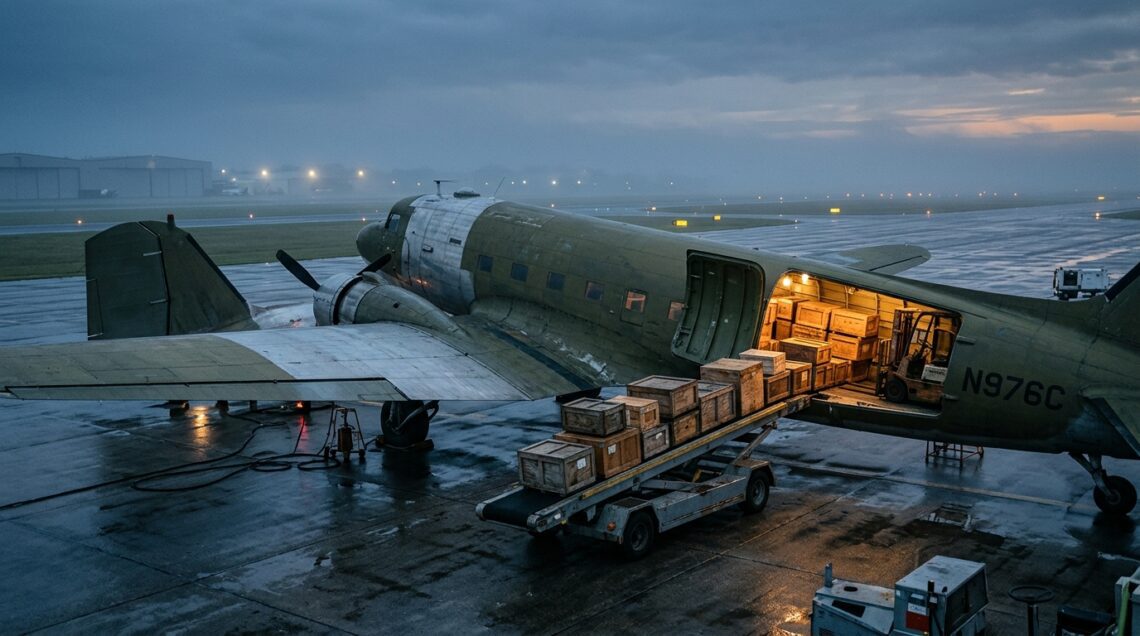
The First Flight Carried Perishables
Introduction
On 25 August 1919, the world’s first daily international scheduled air service launched between London and Paris. The Aircraft Transport and Travel Limited flight carried a single passenger, some newspapers, and cargo that included Devonshire cream, jam, and grouse.
Perishables flew before regular passengers did.
This wasn’t coincidence. The operators who launched commercial aviation understood something fundamental: if aeroplanes could move cargo faster than any other transport mode, perishable goods would benefit most. A jar of jam that might spoil on a slow boat could arrive fresh by air. A grouse shot in Scotland could reach a Parisian restaurant while still prime.
The economics of early aviation made this insight essential. Aeroplanes were expensive to operate—fuel costs, pilot salaries, maintenance, and the aircraft themselves required revenues that passenger fares alone couldn’t always provide. Cargo filled the gap, and perishable cargo commanded premium prices because speed was worth paying for.
From that first London-Paris flight, air freight and the cold chain have evolved together. Today, 95% of all exported flowers travel by air. Vaccines reach remote clinics within hours of manufacture. Life-saving medications move across continents in temperature-controlled containers monitored by satellite.
This is the story of how aviation became the cold chain’s express lane—and how that capability transformed African economies, global health, and the very concept of “fresh.”
The Speed Equation
To understand why air freight matters for perishables, consider the mathematics of spoilage.
Time Is the Enemy
Every perishable product exists on a timeline running from optimal condition to waste. The length of that timeline varies dramatically:
- Cut flowers: 7-14 days from harvest to consumer (depending on variety and handling)
- Fresh fish: 5-10 days properly refrigerated
- Leafy vegetables: 3-7 days
- Bananas: 21-28 days (controlled ripening)
- Vaccines: Varies by product, but many require administration within hours of removal from cold storage
The cold chain extends these timelines by slowing biological processes—respiration in produce, bacterial growth in proteins, chemical degradation in pharmaceuticals. But even with perfect temperature control, time accumulates.
The Air Advantage
Compare transit times from Nairobi to Amsterdam:
- Ocean freight: 18-25 days (via Mombasa, around the Cape or through the Suez Canal)
- Air freight: 8-12 hours
For cut flowers with a 10-day vase life, ocean freight would consume the entire window before reaching consumers. Air freight delivers the same flowers with 9+ days of freshness remaining.
This arithmetic explains why certain products—flowers, certain pharmaceuticals, high-value fresh produce—moved to air freight as soon as cargo aviation became commercially viable.
The Cost-Value Calculation
Air freight costs significantly more than ocean or road transport per kilogram. This makes it economically viable only when:
- Product value is high enough to absorb transport costs
- Time sensitivity is critical (spoilage risk exceeds freight premium)
- No viable surface alternative exists (geographic constraints)
- Speed enables market opportunities (reaching consumers during peak demand)
Flowers from Kenya to Europe exemplify all four factors. Roses command prices that absorb air freight costs. Spoilage risk is severe. Ocean freight takes too long. And reaching the Valentine’s Day or Mother’s Day market requires precise timing.
The African Flower Revolution
Perhaps nowhere has air freight cold chain capability transformed an economy more dramatically than in East African floriculture.
The Netherlands Paradox
For most of the 20th century, the Netherlands dominated global flower production and trade. Dutch greenhouses, heated through cold winters, produced tulips, roses, and other flowers that the country’s legendary auction houses—particularly Royal FloraHolland—distributed worldwide.
But heated greenhouses consume enormous energy. The 1973 oil crisis and subsequent energy price increases made Dutch production increasingly expensive. At the same time, air freight capability was expanding globally.
The economics began favouring production in regions with natural growing conditions—equatorial climates with consistent temperatures, adequate sunlight, and ample water—combined with air links to consuming markets.
Kenya’s Rise
Kenya possessed ideal conditions for floriculture:
- Equatorial location providing consistent daylight year-round
- Highland elevations (around Lake Naivasha) with moderate temperatures
- Abundant water
- Available labour at competitive costs
- Jomo Kenyatta International Airport in Nairobi with growing cargo capacity
In the 1980s, Kenyan flower exports were minimal. By 2017, Kenya was exporting 160,000 tonnes of cut flowers annually, earning over $800 million. Kenya became Africa’s largest flower exporter and the world’s third-largest overall, supplying nearly 40% of cut flowers imported by the European Union.
Ethiopia’s Growth
Ethiopia followed a similar trajectory, though with more deliberate government involvement. The Ethiopian Horticulture Producer Exporters Association (EHPEA) reports that flower exports now earn the country over $500 million annually.
Ethiopian Airlines, state-owned and strategically developed, became a key enabler. The airline offers dedicated cargo flights carrying 85 tonnes of flowers daily to European markets. Addis Ababa Bole International Airport developed modern cold chain facilities specifically to support perishable exports.
Ethiopia’s airfreight rates run approximately half those charged in Kenya, providing competitive advantage even as Kenya’s infrastructure remains more extensive.
The Cold Chain Imperative
The success of East African floriculture depends entirely on unbroken cold chain from farm to consumer.
The process works as follows:
- Harvest: Flowers are cut at optimal stage, typically early morning when temperatures are coolest
- Field Cooling: Immediate placement in cold water or hydration solutions at the farm
- Transport to Pack House: Refrigerated trucks move flowers to processing facilities
- Grading and Treatment: Quality sorting, fungicide treatment, and preparation for export—all in temperature-controlled environments
- Packing: Flowers are packed into cartons designed for airfreight, maintaining cold conditions
- Transport to Airport: Refrigerated trucks move packed flowers to cargo facilities
- Airport Cold Storage: Flowers wait in refrigerated facilities until flight departure
- Loading: Temperature-controlled handling minimises exposure during aircraft loading
- Flight: Cargo holds maintain appropriate temperatures during transit
- Destination Handling: Cold chain continues through customs and delivery to auction houses or direct buyers
- Onward Distribution: Further refrigerated transport to retailers and ultimately consumers
A break at any stage—a truck without refrigeration, an airport facility at wrong temperature, cargo sitting on hot tarmac—damages quality and shortens vase life.
Kenya’s Jomo Kenyatta International Airport has invested heavily in cold chain infrastructure. The cargo handling area includes dedicated refrigerated space capable of maintaining temperatures between -18°C and +2°C. Similar investments at Addis Ababa Bole International Airport support Ethiopian exports.
The Pharmaceutical Revolution
While flowers demonstrated air freight cold chain’s commercial potential, pharmaceuticals revealed its life-saving importance.
Temperature-Sensitive Medications
Many medications require temperature control to maintain efficacy:
- Vaccines: Typically 2°C to 8°C, though some require frozen or ultra-cold storage
- Insulin: 2°C to 8°C for unused vials; room temperature once opened
- Biologics: Various requirements, often very precise
- Blood products: Temperature and time-critical
- Certain antibiotics: Temperature-sensitive formulations
Unlike flowers, where quality degradation means commercial loss, pharmaceutical temperature excursions can cause medical harm. A vaccine that appears normal but has been heat-damaged may provide no protection—leaving patients vulnerable to diseases they believe they’re protected against.
The Vaccine Cold Chain
The World Health Organization’s Expanded Programme on Immunization (EPI), launched in 1974, created systematic global vaccine cold chains for the first time.
The challenge was enormous: vaccines manufactured in a handful of locations needed to reach clinics in remote areas of developing countries, maintaining temperature throughout journeys that might take weeks and cross multiple transport modes.
Air freight became essential for the international legs of vaccine distribution. Vaccines could move from manufacturer to national capitals in hours rather than weeks, preserving their potency for the longer ground-based journeys that followed.
The WHO developed extensive guidance on vaccine cold chain management, including:
- Temperature monitoring requirements
- Equipment specifications for refrigerators and cold boxes
- Training protocols for health workers
- Quality assurance systems
This infrastructure—the “vaccine cold chain”—would prove critical decades later.
COVID-19: The Ultimate Test
The COVID-19 pandemic created unprecedented cold chain demands.
Some COVID-19 vaccines required ultra-cold storage: the Pfizer-BioNTech vaccine initially required -70°C, far colder than standard pharmaceutical cold chains. This created what observers called a “colder chain”—new infrastructure capable of temperatures never before required at scale.
Air freight was essential for vaccine distribution. Speed mattered enormously: every day of delay meant more infections, more deaths. Vaccines needed to reach every country simultaneously, not sequentially. Only air transport could provide the necessary global coverage within acceptable timeframes.
The industry responded with remarkable capability. Airlines reconfigured passenger aircraft for cargo. Cold chain logistics providers invested in ultra-cold equipment. Monitoring systems tracked shipments in real time across multiple continents.
The COVID vaccine distribution demonstrated both the maturity of air freight cold chains and their limitations. Wealthy countries with developed cold chain infrastructure received vaccines first. Countries without such infrastructure—or without airports capable of handling temperature-sensitive cargo—waited longer.
South Africa’s Position
South Africa occupies a distinctive position in African air freight cold chains—developed infrastructure serving a relatively small perishable export sector, combined with significant pharmaceutical cold chain requirements.
Flower Exports: A Smaller Player
Unlike Kenya and Ethiopia, South Africa is not a major flower exporter. Higher labour costs, distance from European markets, and competition from East African producers limit the industry.
However, South Africa does export indigenous flowers—proteas, fynbos varieties, and other species that cannot be grown elsewhere. These niche products command premium prices that justify air freight costs.
South African floriculture also imports. Cut flowers from Kenya, Zimbabwe, and Zambia enter South Africa by both road and air for domestic consumption, taking advantage of the country’s advanced cold chain infrastructure for onward distribution.
Pharmaceutical Significance
South Africa’s more significant role in air freight cold chains involves pharmaceuticals. The country serves as a regional hub for medication distribution, with Johannesburg’s OR Tambo International Airport handling substantial pharmaceutical cargo for Southern Africa.
The Biovac Institute—South Africa’s public-private vaccine manufacturer—represents growing domestic pharmaceutical production capability. As local vaccine manufacturing expands, cold chain logistics from production facilities to distribution points will become increasingly important.
South Africa’s cold chain infrastructure, originally developed for fruit exports, provides foundation for pharmaceutical distribution. The same cold stores, refrigerated trucks, and handling facilities that serve agricultural exports can support pharmaceutical logistics—though pharmaceutical requirements often exceed agricultural standards.
Airport Infrastructure
OR Tambo International Airport in Johannesburg handles significant cold chain cargo. The airport’s cargo facilities include temperature-controlled zones, though the facility faces the same capacity and efficiency challenges that affect South African logistics generally.
Cape Town International Airport serves agricultural exports from the Western Cape, including time-sensitive produce like berries and speciality vegetables that may move by air.
The same altitude considerations that affect refrigerated trucking apply to ground operations at Johannesburg’s airport: equipment operating at 1,700 metres performs differently than at sea level.
The Physics of Air Freight Cold Chain
Air freight cold chains face distinctive physical challenges.
Temperature Variations in Flight
Aircraft cargo holds experience temperature variations depending on aircraft type, hold location, and operational factors:
- Lower deck cargo holds on passenger aircraft are typically maintained above freezing to prevent damage to passengers’ luggage, but not precisely controlled
- Main deck freighter cargo areas may have temperature control capability
- Ground handling exposes cargo to ambient conditions during loading and unloading
These variations require robust packaging. Perishable cargo travels in insulated containers or with gel packs, phase-change materials, or other passive cooling that maintains temperature during flight and handling.
The Ground Time Problem
Paradoxically, the greatest risk to air freight cold chains often occurs on the ground, not in the air. A shipment might fly for 8 hours but spend 4 hours on airport tarmac in tropical heat during loading and unloading.
Solutions include:
- Temperature-controlled dollies and ground support equipment
- Rapid handling protocols minimising tarmac time
- Cool rooms at airports for staging before and after flights
- Real-time temperature monitoring that alerts handlers to problems
East African flower exporters have driven investment in ground handling infrastructure precisely because flowers are so sensitive to temperature excursions during handling.
Altitude and Pressure
Aircraft cargo holds experience reduced pressure at cruising altitude—not a vacuum, but lower than sea level. This affects some products:
- Flexible packaging may expand
- Pressure-sensitive products may be affected
- Some living products (flowers are still respiring) may respond to atmospheric changes
Proper packaging accounts for these factors, but the effects differ from surface transport conditions.
Power Limitations
Active refrigeration during flight requires power. While some aircraft offer powered cargo positions (particularly for pharmaceutical shipments), many perishable shipments rely on passive cooling—insulation and cold packs rather than mechanical refrigeration.
This means pre-cooling is essential. Cargo must enter the aircraft at target temperature because there’s limited ability to cool it during flight. The same lesson learned with refrigerated ships in the 1880s—pre-cooling is non-negotiable—applies to air freight.
Modern Innovations
Air freight cold chains continue evolving with technological advances.
Controlled Atmosphere Containers
Beyond temperature control, some shipments benefit from controlled atmosphere—regulated levels of oxygen, carbon dioxide, and nitrogen that slow respiration and extend shelf life.
For flower shipments, controlled atmosphere can extend vase life beyond what temperature control alone achieves. The technology is more expensive but creates additional market opportunities, particularly for distant destinations like Asia.
Real-Time Monitoring
Modern temperature monitoring devices track conditions throughout shipments and transmit data via satellite or cellular networks. Shippers can observe temperature, location, and container status in real time from anywhere in the world.
This visibility enables proactive intervention. If a shipment experiences a temperature excursion, the shipper knows immediately rather than discovering the problem at destination. Alternative handling, rerouting, or customer notification can occur before cargo is lost.
Blockchain and Documentation
International perishable shipments involve extensive documentation—phytosanitary certificates, customs declarations, temperature records, handling logs. Blockchain-based systems are beginning to link these documents in tamper-resistant chains that all parties can access.
Kenya’s participation in pilot programmes for UK-Kenya digital trade corridors demonstrates how technology may streamline cold chain documentation while improving accountability.
Ocean-Air Combinations
The traditional choice between slow/cheap ocean freight and fast/expensive air freight is becoming more nuanced.
Some flower exporters now use ocean freight with advanced reefer containers for certain routes, accepting longer transit times in exchange for dramatically lower costs. Controlled atmosphere containers make this viable for products that previously required air freight.
Hybrid routings—air freight for the most time-sensitive leg, connecting to ocean or surface transport for other segments—optimise cost and speed based on specific product requirements.
Lessons for South African Operations
The air freight cold chain’s evolution offers insights relevant to South African cold chain development.
Infrastructure Investment Pays
Kenya’s dominance in flower exports stems partly from natural conditions but significantly from infrastructure investment. Jomo Kenyatta International Airport’s cold chain facilities, developed specifically for perishable exports, enable the industry’s growth.
South African airports have capable facilities, but targeted investment in cold chain infrastructure could support higher-value perishable exports—particularly pharmaceutical manufacturing as the sector develops.
Integration Matters
The most successful air freight cold chains involve close coordination between producers, freight forwarders, airlines, and handlers. Kenya’s flower industry works because all parties understand their roles in maintaining the cold chain.
South African cold chain development benefits from similar integration thinking—not just individual capable facilities but coordinated handoffs between links.
Speed Creates Markets
Air freight capability doesn’t just serve existing demand; it creates new market opportunities. Products that couldn’t reach distant consumers fresh can now do so. Seasons can extend. Niche products find global audiences.
As South African speciality agriculture develops—indigenous flowers, unique produce varieties, premium products—air freight cold chains can open markets that surface transport cannot reach.
Pharmaceutical Cold Chains Have Different Requirements
The precision required for pharmaceutical cold chains exceeds most agricultural applications. Temperature ranges are tighter. Documentation requirements are more stringent. Regulatory oversight is more intensive.
As South African pharmaceutical manufacturing grows, cold chain capabilities must grow correspondingly. The skills and infrastructure from agricultural cold chains provide foundation but not completion.
Conclusion: The Express Lane Expands
When Aircraft Transport and Travel Limited loaded Devonshire cream onto the first scheduled London-Paris flight in 1919, the operators were simply filling cargo space with products that benefited from speed. They couldn’t have imagined that a century later, their practical decision would prefigure an industry moving millions of tonnes of perishables by air annually.
The air freight cold chain evolved from commercial opportunism to essential infrastructure. Flowers from Kenya reach European consumers within hours of cutting. Vaccines manufactured in Belgium or India reach clinics on every continent within days. Fresh fish from one hemisphere appears on restaurant tables in another while still at peak quality.
This capability required solving physics problems—maintaining temperature through altitude changes, pressure variations, and ground handling challenges. It required building infrastructure—cold storage at airports, temperature-controlled handling equipment, monitoring systems spanning continents. It required developing expertise—understanding product requirements, optimising routes and schedules, managing the documentation that international perishable trade demands.
South Africa participates in this global system as both origin and destination. Agricultural products leave Johannesburg and Cape Town for international markets. Pharmaceuticals arrive for distribution across Southern Africa. The infrastructure supporting these movements—the airports, the handlers, the cold stores, the trucking that connects them—represents cumulative investment in cold chain capability.
The express lane keeps expanding. New monitoring technologies provide visibility never before possible. Controlled atmosphere extends what air freight can economically carry. Digital documentation systems streamline the paperwork that international cold chain shipments require.
From Devonshire cream to COVID vaccines, air freight cold chains have grown to serve purposes their pioneers never imagined. The fundamental insight, though, remains unchanged: for perishables, speed has value. Aviation provides that speed. The cold chain makes it useful.
Sources & References
Historical Aviation
- Cold Chain Packing & Logistics. “The Development of Cold Chain Solutions in the Healthcare Industry.”
- DSV/Panalpina. “How the Cold Chain and Freight Forwarders Have Evolved Together.”
- EHS Africa Logistics. “How the Cold Chain and Freight Forwarders Have Evolved Together.”
African Flower Industry
- Maersk. “Cold Chain Logistics Trends for African Flowers.”
- DHL. “Kenyan Flower Exports in Full Bloom.”
- Logistics Update Africa. “Fresh, Fast & Forward.”
- Conqueror Network. “Independent Freight Forwarders Guide to Flower Logistics in Africa.”
- Nippon Express. “Cold Chain Development for Flower Exports in East Africa.”
- Globalia Logistics Network. “African Cut Flower Logistics Industry.”
- PMC/National Institutes of Health. “The Economics of Africa’s Floriculture Air-Cargo Supply Chain.”
- NTU Singapore. “Kenyan Flower Exports to Europe Strained by Airfreight Capacity Shortage.”
- Freight News SA. “Exports from Kenya Blossom on the Back of Valentine’s Day.”
Pharmaceutical Cold Chain
- PubMed. “The Origins of the Vaccine Cold Chain and a Glimpse of the Future.”
- Wikipedia. “Cold chain.”
- IOA. “Boosting Africa’s Cold Chain to Transport Refrigerated Items.”
Industry Analysis
- Cargo Flowers. “Flower Industry Logistics.”
- Cross Dock Insights. “Cold Play: Inside America’s Chilling Logistics Revolution.”
- Transport Geography. “The Cold Chain and its Logistics.”
- Maersk. “Cold Chain Logistics for Perishables.”
Related Resources:
- Cold Chain Glossary: Technical terms including air freight terminology
- Technology Directory: Monitoring and tracking solution providers
- Transport Directory: Air freight and logistics service providers
- Pharmaceutical Cold Chain Guide: GDP compliance requirements
About ColdChainSA
ColdChainSA.com is South Africa’s dedicated cold chain industry directory and resource platform. We connect cold chain operators with equipment suppliers, technology providers, and service companies while providing authoritative technical content on temperature-controlled logistics.