
The Cold Chain Starts Too Late
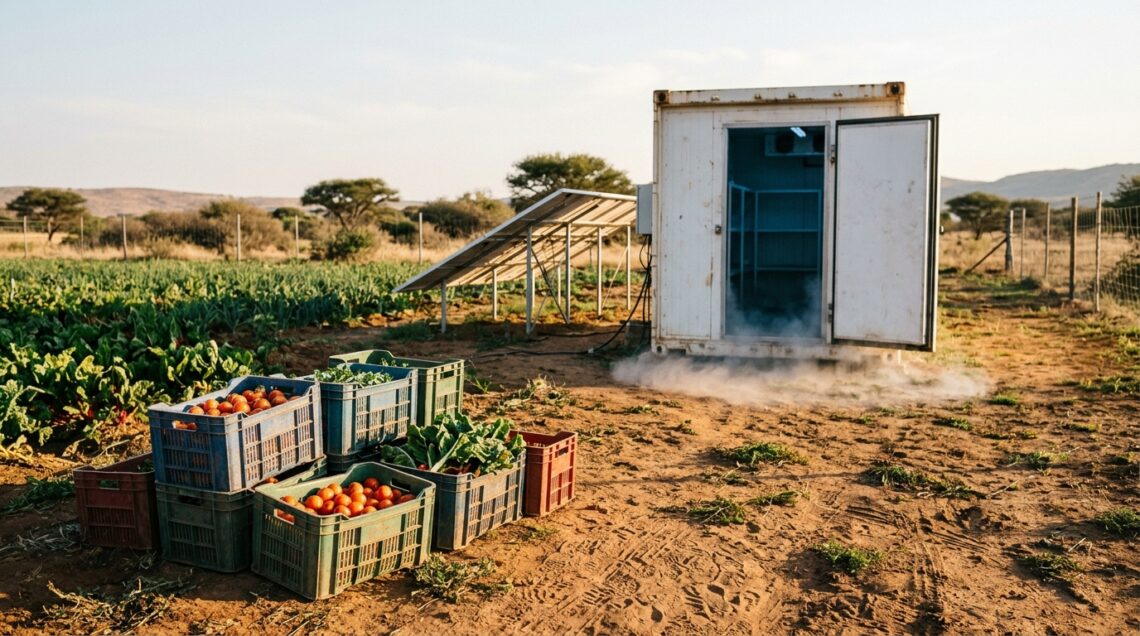
Ask where South Africa’s cold chain begins and most people will point to a building: a packhouse cold room, a distribution centre, a reefer container. For fresh produce that is already too late.
Fruit and vegetables keep living after they are picked. They respire, lose moisture and ripen, and the warmer they are, the faster all of it happens. Produce picked on a hot afternoon carries the field’s heat with it, and every hour that heat stays in the crate is shelf life the consumer will never see. Post-harvest specialists draw a sharp line between pre-cooling, which removes field heat quickly after harvest, and cold storage, which only holds a temperature that has already been reached. A cold room cannot undo the hours before produce reaches it.
The numbers show where the damage is done. In Ikechukwu Opara’s research on pomegranates, 15–20% of the crop was lost on the farm, mainly to sunburn and cracking, and another 7–8% at the packhouse. That is before the fruit reaches the wholesale markets, where his team measured a further 9,000 to 18,000 tonnes of losses a year.
This summer the first mile gets harder. The South African Weather Service expects a strong to very strong El Niño, with heat and below-normal rainfall over much of the north-east. More heat means more field heat, and less time between harvest and damage.
Three First-Mile Stories From October
A packhouse in Mogogelo. In October the North West Department of Agriculture and Rural Development handed over the Cassper Agri-Life vegetable packhouse in Mogogelo village, Moretele. It came with production tunnels, a borehole, a backup generator and mobile cold rooms. It is the department’s third packhouse launch. It is welcome. But the announcement did not say who operates the cold rooms, what farmers pay to use them, how the electricity and the generator’s diesel are funded, or who maintains the equipment.
Dairy farmers quitting in the Free State. Researchers at the Agricultural Research Council (ARC) describe smallholder dairy farmers leaving the industry. The most significant challenge they name is infrastructure: no milk storage and no cooling. Milk quality falls quickly if it is not cooled soon after milking, and commercial bulk tanks must cool milk to 5 °C or lower within about three hours. Farmers far from collection points, producing small volumes that do not meet processors’ standards, end up accepting whatever price is offered or selling to traders for less.
An idle support unit near Brits. African Farming’s editor, Lebogang Mashala, visited the Jericho Farmer Production Support Unit, a government-supported feedlot near Brits. He found no livestock. He was told activity had stalled after the agriculture and land reform departments separated. His warning applies to every facility built with public money: without technical assistance, monitoring and maintenance, it “risks becoming an idle asset”.
Three different stories, one pattern. The building is the easy part. Running it is the hard part.
What Kenya Got Right
Kenya loses an estimated 30–40% of its harvest after harvest, worth about US$578 million a year. In Kinale, Kiambu County, a 5-tonne solar cold room with a built-in pre-cooling unit serves a farmer-led aggregation business of 250 smallholders. The pre-cooler strips field heat from produce before storage. According to the report, post-harvest losses in that enterprise fell to single digits, and farmers’ prices rose by an average of 50%.
The technology is not the lesson. The same report warns that cooling equipment installed without a clear business model has failed or gone underused across the region, “especially due to high energy costs”. What worked was the combination:
- Farmers pooled their produce, so the cold room had a steady load.
- Farmers tried the equipment before investing, under a “try before you buy” approach, so the business case was proven first.
- There was a buyer at the other end, so cooled produce earned a better price.
Experts interviewed by Africa.com in October put it more bluntly. “The biggest gap is not awareness but aggregation and intentional market design,” said Olamide Niyi-Afuye of the Africa Minigrid Developers Association. FSD Kenya’s Mugwe Manga noted that lenders can back one identifiable operator far more easily than many individual smallholders. Larger projects follow the same logic. Cold Solutions Rwanda has secured up to US$18 million for a Kigali facility of 4,000 pallets, expandable to 8,000, with a professional operator from day one.
A Cold Room Is Not a Cold Chain
A first-mile cold room becomes part of a cold chain only when six things are in place. Most failed projects are missing at least two of them.
- An operator who is accountable. One named business or cooperative runs it, opens it at 5 a.m. in harvest week, and answers for it when the compressor stops.
- A fee that covers the running cost. Pay-per-crate or pay-per-day pricing makes the room pay for its own electricity, maintenance and replacement. A free facility has no budget for the day it breaks.
- An energy plan sized for summer. Solar with batteries or thermal storage, or grid power with a backup, sized for the hottest week of the year, not the average one. A backup generator is only a plan if its diesel is in the budget.
- A buyer before the harvest. Contract models such as eFama’s agree the buyer, price and specification before planting. Cold storage adds the option to hold produce for a better offer instead of selling at the end of the day at any price.
- A cold link onward. A cold room at the farm gate helps only if the next leg to the packhouse, market or processor keeps the produce cold. A refrigerated collection on a schedule turns two cold points into a chain.
- Measurement. Pallets in and out, temperatures and losses, recorded from the first week. It is the only way to prove the room works and to justify the next one.
For milk the same logic applies, but with a deadline of hours. Where individual farmers cannot afford a bulk tank, a shared cooling point within reach of several farms, run by one operator and collected on a schedule, turns small volumes into one consignment that meets a processor’s standard.
What This Means for Public Money
Government is right to fund first-mile infrastructure. The R1.2 billion Integrated Land Reform and Rural Development Support Programme launched in October, and R650 million in pledges to the Land Bank’s blended finance scheme, show the intent. The question is what the money buys.
Funding the building without the operating model buys a ribbon-cutting. Funding the model buys a working cold chain. In practice that means:
- Handing every facility to a named operator, with a contract and targets, not just to a beneficiary.
- Budgeting the first two years of running costs, energy and maintenance included, so the facility survives until its fees can carry it.
- Measuring use, not launches: pallets cooled per week, not facilities opened per year.
- Pairing each cold room with a buyer and a collection route before construction starts.
Mashala made the same point about programmes in general: judge them by what they achieve, not by how many are launched or how much is announced.
Where the Food Is
In Enough Food, Wrong Place we argued that the local cold chain will have to catch more of what does not leave the country, as export doors narrow and El Niño heats the summer. The first mile is where that chain begins, and right now it begins hours too late.
The fix is not more cold rooms on their own. It is cold rooms that someone runs, that pay for themselves, that have a buyer at the other end and a cold truck in between. That is the difference between a building and a chain, and it is the difference between a harvest that reaches a table and one that rots in the field.
Sources & References
South African first-mile stories
- Mogogelo farmers receive packhouse and cold storage facilities, Food For Mzansi, 22 October 2026.
- Why Free State smallholder dairy farmers are quitting the industry, Adam Swarahla and Dr Walter Shiba (ARC), Food For Mzansi, 13 October 2026.
- Farmers cannot plant promises: Lebogang Mashala asks where the billions go, African Farming, 30 October 2026.
- From farm to fintech: using tech to transform South Africa’s food supply chain, Financial Mail, 30 September 2026. eFama.
Field heat and losses
- South Africa produces enough food, yet millions face hunger. Better cold storage could help change that, Ikechukwu Opara and Frederic Isingizwe, via The Conversation / Phys.org, August 2026.
- The first hours after harvest: why a cold room can already be too late, ColdHubs, 29 August 2026.
- Pre-Cooling: Essential for Improving Postharvest Management of Horticultural Crops, Wikifarmer.
Models that work
- Narrowing Kenya’s cold chain gap with solar technology, Africa.com, 21 October 2026.
- Renewables, farmer aggregation offer solutions to Africa’s post-harvest losses, Africa.com, 28 October 2026.
- Cold Solutions Rwanda secures up to USD 18M for a Kigali cold-chain facility, WeeTracker, 5 October 2026.
- CIMA names KilimoChills Solution inaugural Lions’ Lair Africa winner, Lifestyle & Tech, 5 November 2026. Solar cold storage for market traders.
Weather
- Uncertainty is high as the 2026-27 summer crop season starts, Wandile Sihlobo, Daily Maverick, 11 October 2026.
ColdChainSA Analysis
- Enough Food, Wrong Place: AGOA, Hunger and the Cold Chain That Catches What Doesn’t Leave, ColdChainSA, November 2026.
- Food Processing and Cold Chain in Southern Africa: Why Aseptic Isn’t a Bypass, ColdChainSA.
- From Port to Plate: The Cold Chain Gap Between Export Fruit and Township Tables, ColdChainSA. The last mile.
- Powering the Cold Chain: Renewable Energy Solutions for South African Cold Storage Operations, ColdChainSA.
- Mapping South Africa’s Cold Storage Gap: A Provincial Assessment, ColdChainSA.
Operational disclosure
The publisher of ColdChainSA also operates The Frozen Food Courier®, a refrigerated courier service active in Gauteng and the Western Cape.