
Stopping Heat Before It Starts
How ceramic coatings, optimised insulation, and thermal storage can multiply the effectiveness of electric, solar, and cryogenic refrigeration systems
The conversation around zero-emission refrigerated transport typically focuses on one question: how do we power the refrigeration unit without diesel? It’s the right question—but it’s incomplete.
There’s a complementary approach that receives far less attention: reducing how much cooling the loadbox needs in the first place. A trailer that maintains temperature for six hours without active refrigeration fundamentally changes what’s possible with electric, solar, or cryogenic systems. Range limitations shrink. Battery requirements decrease. The entire economics of zero-emission transport improve.
This article examines practical technologies that South African operators can implement today—ceramic reflective coatings, optimised polyurethane insulation, and phase change thermal storage. No exotic materials requiring international sourcing. No fragile components demanding special handling. Just proven technologies combined intelligently to transform trailer thermal performance.
The Core Concept
Every refrigerated trailer fights the same battle: heat wants to get in, and the refrigeration system works constantly to remove it. In South Africa, that battle has a dominant enemy: the sun.
On a summer day, a trailer roof can reach 60-70°C surface temperature. That superheated surface then conducts heat through the insulation into your cargo space. Your refrigeration system runs continuously, burning diesel or draining batteries, fighting heat that started as sunlight hitting your roof hours ago.
The conventional approach accepts this: build thicker insulation, run bigger refrigeration systems, burn more fuel. But there’s a smarter approach—stop the heat at the surface before it ever reaches the insulation.
This is where ceramic reflective coatings change the equation. Applied to the exterior, they block up to 95% of solar radiation before it can heat the trailer surface. A roof that would reach 65°C instead stays at 30-35°C—near ambient temperature. The insulation behind it has far less heat to manage.
Combine this with optimised insulation specification and phase change materials for thermal storage, and you create a loadbox that dramatically reduces cooling demand. For zero-emission refrigeration systems with finite energy supplies, this isn’t just helpful—it’s transformative.
The Three-Layer Defence: Coating, Insulation, and Thermal Mass
Effective thermal loadbox design uses three complementary technologies, each addressing different aspects of heat management.
Layer One: Ceramic Reflective Coatings
Ceramic reflective coatings represent the most cost-effective intervention available to refrigerated transport operators. Unlike standard white paint that reflects only visible light, ceramic coatings block heat across the full solar spectrum—visible light, ultraviolet, and critically, infrared radiation.
Products like Super Therm contain four unique ceramic compounds developed through NASA research, achieving 95%+ solar heat blocking. The coating is applied at just 250 microns (0.25mm) thickness, yet it prevents the vast majority of solar energy from ever heating the trailer surface.
The performance data from refrigerated transport applications is compelling:
- Polish comparative study: Two identical refrigeration trucks, one with ceramic-coated roof, one without, tested side by side in direct sunlight. The coated truck achieved target temperature faster, with the refrigeration unit running 40 minutes less over the test period—a 19% energy reduction.
- US fleet testing (ICAG): Ceramic coating on trailer roofs reduced refrigeration fuel consumption by approximately 30%. Cool-down time was cut by 1.75 hours (44% improvement). Hot-haul fuel savings reached 20%, with cold-return savings of 29%.
- Australian operator experience: Hard Produce Transport Services reported that after coating, “the Thermo King refrigeration units started cycling correctly”—the refrigeration system was finally able to keep up with demand because heat ingress had dropped so dramatically.
These aren’t laboratory results. They’re operational outcomes from commercial fleets.
- How ceramic coatings work: The ceramic microspheres in the coating don’t conduct heat. When solar radiation strikes the surface, the ceramics reflect and refract the energy rather than absorbing it. The surface stays cool because the heat never enters the material. This differs fundamentally from standard paint, which absorbs heat and then radiates it inward.
- Durability matters: Quality ceramic coatings maintain performance for 20+ years. Super Therm has documented projects still performing within thermal specifications after 30 years. The coating continues working even when dirty—unlike reflective paints that lose effectiveness as soon as dust accumulates. For commercial vehicles that can’t be washed daily, this sustained performance is essential.
- Application considerations: Ceramic coatings can be sprayed, brushed, or rolled onto clean surfaces. They adhere to metal, fibreglass, and most painted surfaces. Application is straightforward enough for fleet maintenance facilities, though professional application ensures optimal thickness and coverage.
Layer Two: Optimised Polyurethane Insulation
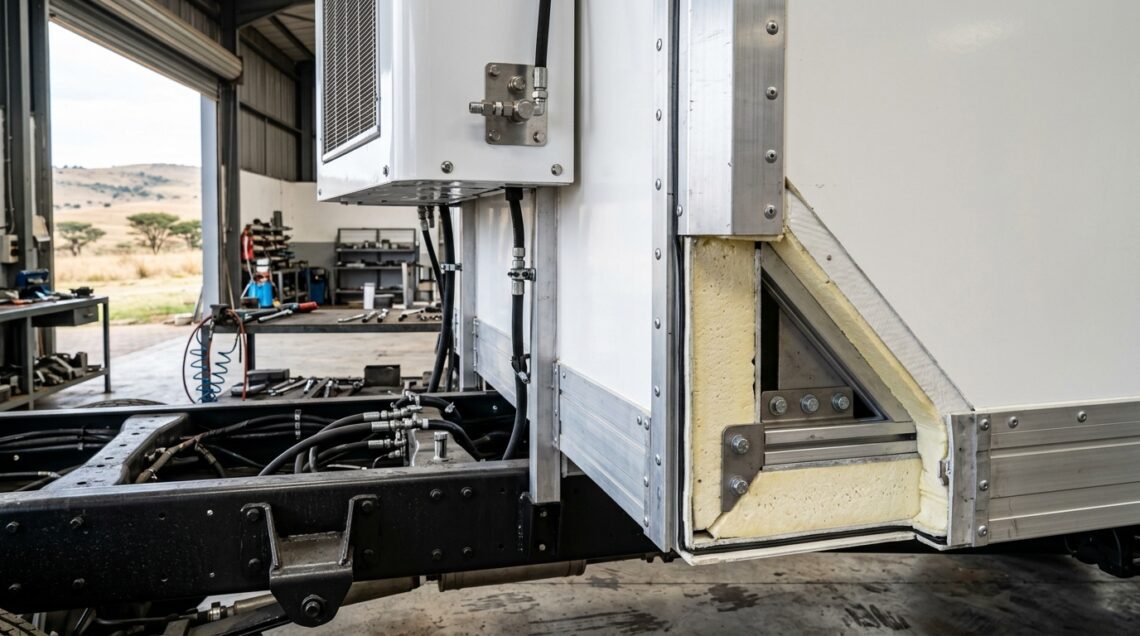
Polyurethane foam remains the workhorse of trailer insulation for good reason—it’s cost-effective, mechanically durable, and well-understood. But not all PUR is equal, and specification choices significantly affect performance.
Standard vs optimised construction:
| Specification | Standard Trailer | Optimised Build |
|---|---|---|
| Sidewall thickness | 60mm | 75-80mm |
| Roof thickness | 80-100mm | 100-120mm |
| Floor thickness | 60mm | 75mm |
| Foam density | 40-45 kg/m³ | 55-65 kg/m³ |
| Thermal conductivity | 0.024 W/mK | 0.020-0.022 W/mK |
Higher-density foam with lower thermal conductivity costs more per cubic metre but delivers meaningfully better insulation. The additional thickness adds modest cost and slightly reduces internal volume, but the thermal performance improvement is substantial—typically 15-25% better than standard specification.
Door and seal optimisation: Doors represent the weakest point in trailer thermal performance. Every door opening floods the cargo space with warm air. Quality construction addresses this through:
- Thicker door panels (matching or exceeding wall specification)
- Multi-chamber seal systems that maintain contact despite wear
- Insulated roller shutters that enable partial opening during loading
- Thermal breaks at hinge points and lock mechanisms
Floor construction: The floor experiences the most mechanical stress from forklift traffic and cargo movement. It also contacts warm road surfaces during operation. Quality floor construction uses reinforced PUR with protective surface layers, maintaining both thermal performance and durability.
Vapour barriers: Moisture penetration into insulation foam degrades thermal performance over time. Quality construction includes vapour-tight surface layers—typically galvanised steel or aluminium—that prevent moisture ingress while providing mechanical protection.
Layer Three: Phase Change Materials for Thermal Storage
Phase change materials store and release thermal energy as they change between solid and liquid states. For refrigerated transport, they act as thermal batteries—”charged” by the refrigeration system and “discharging” by absorbing heat that would otherwise warm the cargo.
The practical impact: A trailer without PCM begins warming immediately when refrigeration stops. Temperature rises steadily as heat conducts through insulation. With PCM, the phase change material absorbs incoming heat without temperature increase until it fully melts. This can extend temperature maintenance from two hours to six hours or more—a transformation for zero-emission systems.
Research outcomes:
- PCM integration in trailer walls can reduce daily refrigeration loads by up to 34%
- Systems designed for frozen transport have maintained -20°C for 24 hours with no active refrigeration
- Energy cost reductions of up to 79% have been demonstrated in research applications
- Temperature fluctuations during door openings are reduced by 2-5°C
Implementation approaches:
- Eutectic plate systems use discrete metal plates filled with PCM solution, typically mounted on ceilings or walls. The plates freeze overnight when connected to power or during refrigeration operation, then absorb heat during delivery runs. Over 20,000 vehicles globally use eutectic systems, primarily for frozen food and ice cream distribution.
- Eutectic plates offer practical advantages: they can be retrofitted to existing trailers, they’re serviceable if damaged, and they’re available from established suppliers. The trade-off is reduced cargo space (plates typically mount on ceiling or walls) and concentrated weight.
- Wall-integrated PCM embeds phase change material within panel construction, either as a separate layer or microencapsulated within insulation foam. This provides distributed thermal mass without sacrificing cargo space. However, it requires manufacturing integration and isn’t available as a retrofit.
- Ceiling-mounted PCM panels position thermal mass above cargo, absorbing heat from the roof (the highest solar load surface even with ceramic coating) and cooling descending air. This keeps floor and walls clear for cargo handling while providing thermal buffering where it’s most needed.
- Weight considerations: PCM adds weight. A comprehensive system can add 100-400kg depending on configuration. For weight-sensitive operations, this matters. However, the weight often displaces nothing useful—ceiling-mounted panels use otherwise empty space—and the operational benefits typically outweigh the modest payload reduction.
The Combined Effect: How These Technologies Multiply
Each technology addresses different aspects of heat management. Combined, they create multiplicative rather than additive benefits.
- Ceramic coating stops 95% of solar radiation at the surface. Instead of a 65°C roof conducting heat inward, you have a 32°C roof—nearly ambient temperature. The insulation behind it faces dramatically reduced heat load.
- Optimised insulation manages the remaining heat ingress with maximum efficiency. Better foam density and appropriate thickness slow conductive heat transfer. Quality seals and thermal breaks eliminate weak points.
- Phase change materials absorb whatever heat does get through, preventing temperature rise in the cargo space. The thermal mass buffers temperature fluctuations from door openings and provides extended autonomous operation when refrigeration isn’t running.
- The multiplicative effect: If ceramic coating reduces roof heat load by 75%, optimised insulation reduces conducted heat by 25%, and PCM absorbs 50% of remaining ingress, the combined effect isn’t 75% + 25% + 50% = 150%. It’s closer to: 100% heat → 25% reaches insulation → 19% conducts through → 9.5% reaches cargo space. That’s over 90% reduction in effective heat ingress.
Real-world results won’t quite match theoretical calculations—doors open, conditions vary, nothing is perfect. But the combined approach routinely achieves 50-70% reduction in refrigeration energy demand. For zero-emission systems, that’s transformative.
Benefits for Zero-Emission Refrigeration
Each zero-emission technology benefits from reduced cooling demand, but the specific advantages vary.
AxlePower Systems
Thermo King’s AxlePower generates electricity from trailer wheel rotation. When the trailer is moving, it produces abundant power. When stationary—at loading docks, overnight parking, during traffic delays—generation stops.
Thermally optimised loadboxes extend the window AxlePower can handle without diesel backup. The documented 97% electric operation rate could potentially reach 99%+ with reduced heat ingress. Stationary periods that currently challenge the system become manageable when the trailer isn’t fighting constant heat gain.
Solar-Hybrid Systems
Solar panels charge batteries during daylight, but generation drops to zero overnight. Battery capacity must bridge the gap until sunrise. Larger batteries mean more weight and cost.
Reduced cooling demand means smaller batteries can maintain temperature through the night. Alternatively, existing battery capacity provides longer autonomous operation, creating margin for cloudy days or extended routes. The R60 million annual diesel savings Shoprite achieves could grow further with thermally optimised trailers requiring less overnight cooling.
Cryogenic Systems
Liquid nitrogen systems carry limited nitrogen supply. When it’s depleted, the trailer needs refilling at an equipped depot. This constrains route options and operational flexibility.
Reduced cooling demand extends nitrogen supply duration proportionally. A system currently providing 8 hours of operation might stretch to 12 hours with thermal optimisation. Routes previously impractical due to depot locations become feasible. The infrastructure limitation that constrains cryogenic adoption loosens.
Full Battery-Electric
Electric trucks have fixed battery capacity divided between traction and refrigeration. Every kilowatt-hour consumed by refrigeration reduces driving range. For trucks already range-limited compared to diesel, this matters.
Thermally optimised trailers shift the energy equation. Refrigeration draws less power, leaving more for driving. A truck with 250km refrigerated range might achieve 280km with the same battery. Alternatively, smaller refrigeration systems become viable, saving weight and cost.
Operational Benefits Beyond Energy
Thermal optimisation delivers benefits beyond energy savings.
Temperature Stability
Door openings cause temperature spikes in cargo spaces. Warm air floods in, refrigeration systems labour to recover, and cargo near doors experiences thermal stress. This matters for sensitive products—pharmaceuticals, certain produce, chocolate—where temperature excursions affect quality.
PCM thermal mass absorbs heat pulses from door openings, moderating spikes before they affect cargo. Research shows 2-5°C reduction in temperature fluctuations. For products with tight temperature tolerances, this improved stability reduces spoilage and maintains quality.
Breakdown Resilience
Refrigeration system failures happen. When they do, cargo value often depends on how quickly the problem is resolved. Standard trailers begin warming immediately; by the time a technician arrives, damage may be done.
Thermally optimised trailers buy time. Extended autonomous operation means the trailer maintains temperature while repairs are arranged. A system failure at 4pm might be addressed the next morning without cargo loss. Insurance claims decrease. Customer relationships survive incidents that would otherwise damage them.
Operational Flexibility
Optimised thermal performance enables new operational patterns.
- Night deliveries: Urban noise restrictions often prohibit refrigerated vehicle deliveries during certain hours. Silent operation is possible when trailers can maintain temperature without running refrigeration. Thermally optimised trailers extend viable delivery windows.
- Charging flexibility: For electric systems, optimised trailers can queue for charging without temperature drift. Rather than requiring immediate charging after each route, operations can schedule charging during off-peak periods, reducing electricity costs and smoothing demand on charging infrastructure.
- Extended parking: Trailers can sit loaded overnight, over weekends, or during operational disruptions without temperature concerns. This operational flexibility has value that’s hard to quantify but real for operations management.
South African Considerations
Several factors make thermal loadbox optimisation particularly valuable for South African operations.
Solar Radiation Intensity
South Africa receives significantly higher solar radiation than Northern Hemisphere markets where most trailer technology originates. The theoretical solar constant is 1,361 W/m², but actual ground-level radiation in South Africa routinely exceeds 1,000 W/m² during summer—among the highest in the world.
This makes solar heat management the dominant challenge for refrigerated transport. Ceramic coatings, which address solar radiation directly at the surface, deliver proportionally greater benefit in South African conditions than they would in Europe or North America.
High Ambient Temperatures
Summer temperatures in parts of South Africa regularly exceed 40°C. Urban heat islands—where pavement, buildings, and vehicles create localised warming—can add another 8-11°C to effective ambient temperature.
For a trailer maintaining -20°C in 48°C effective ambient (45°C urban temperature), the temperature differential is 68°C. That’s extreme by global standards and places exceptional demands on both refrigeration systems and insulation.
Every intervention that reduces heat ingress has amplified value in these conditions. The same ceramic coating that saves 20% on refrigeration fuel in Poland might save 30% in Gauteng simply because the baseline heat load is so much higher.
Altitude Effects
Johannesburg sits at 1,750 metres elevation. This affects air-cooled refrigeration system performance—condensers work with less dense air, reducing heat rejection capacity.
Thermal loadbox optimisation helps by reducing the cooling demand that stressed refrigeration systems must meet. A condenser that’s struggling to reject heat at altitude benefits when there’s simply less heat to reject.
Infrastructure Resilience
While load shedding has improved dramatically—from 335 days in 2023 to just 26 hours in 2025—the experience has made South African operators acutely aware of power supply vulnerability.
Thermally optimised trailers provide resilience regardless of power supply. Whether parked at a depot during load shedding or operating on routes where charging infrastructure doesn’t exist, extended autonomous operation maintains cargo integrity. This resilience has value beyond direct energy savings.
Implementation: A Staged Approach
For operators considering thermal loadbox optimisation, a staged approach reduces risk while building capability and capturing quick wins.
Stage 1: Ceramic Coating (Immediate)
Ceramic coating is the lowest-cost, highest-return intervention available. It can be applied to existing trailers without structural modification.
Recommended approach:
- Start with roof coating only—this addresses the highest heat load surface
- Apply to 2-3 trailers initially to verify results in your specific operations
- Measure fuel consumption, temperature stability, and cool-down time before and after
- Expand to remaining fleet and full exterior coating based on results
- Expected investment: R10,000-15,000 per trailer (roof only)
- Expected payback: 12-18 months from refrigeration fuel savings
- Risk level: Low—proven technology, easy to verify results
Stage 2: Specification Upgrade (New Builds)
For new trailer procurement, specify optimised construction:
Insulation:
- Minimum 75mm sidewalls (80mm preferred)
- Minimum 100mm roof (120mm preferred)
- Minimum 75mm floor
- Foam density 55+ kg/m³
- Thermal conductivity 0.022 W/mK or better
Construction:
- Vapour-tight surface layers (galvanised steel or aluminium)
- Multi-chamber door seals
- Thermal breaks at structural connections
- Insulated roller shutters if multi-drop operation
Coating:
- Ceramic reflective coating specified at manufacture
- Full exterior coverage (roof, sides, front)
- Application to manufacturer specification
- Expected premium: 10-20% over standard specification
- Expected benefit: 30-40% reduction in refrigeration energy demand
- Risk level: Low—established materials and methods
Stage 3: Thermal Storage Integration (Targeted Applications)
For operations where extended autonomous operation delivers specific value:
Eutectic plate retrofit:
- Ceiling-mounted plates for frozen distribution
- 100-200kg total system weight
- Overnight charging via standard power connection
- 4-8 hours extended temperature maintenance
New-build PCM integration:
- Work with trailer manufacturer on ceiling-mounted PCM panels
- Specify PCM temperature appropriate to cargo type
- Integrate with multi-temperature zone requirements if applicable
- Expected investment: R30,000-80,000 depending on configuration
- Expected benefit: 4-8 hours extended autonomous operation; 20-30% reduction in active refrigeration time
- Risk level: Medium—requires matching system to operational profile
Stage 4: Multi-Temperature Zone Optimisation
For operations requiring multiple temperature zones:
Internal frame approach:
- Longitudinal rails spanning front bulkhead to rear door frame
- Multiple evaporator mounting points along frame
- Moveable partition walls attached to frame
- No penetration of insulated envelope required
Thermal zone design:
- Dedicate PCM capacity to each zone based on temperature requirements
- Frozen zones need more thermal mass than chilled zones
- Consider door opening frequency by zone when sizing
- Expected complexity: High—requires collaboration with trailer manufacturer
- Expected benefit: Multi-temperature capability without thermal compromise
Cost-Benefit Analysis
The economics of thermal loadbox optimisation are compelling when properly analysed.
Direct Savings: Refrigeration Fuel/Energy
For a diesel TRU consuming 3 litres/hour:
- Annual operating hours: 2,000 (250 days × 8 hours)
- Annual fuel consumption: 6,000 litres
- Annual fuel cost: R138,000 (at R23/litre)
With 25% reduction from ceramic coating + optimised insulation:
- Fuel savings: 1,500 litres/year
- Cost savings: R34,500/year
With additional 15% reduction from PCM integration:
- Additional fuel savings: 900 litres/year
- Additional cost savings: R20,700/year
- Total annual savings: R55,200/year
Investment Recovery
| Intervention | Investment | Annual Savings | Payback |
|---|---|---|---|
| Ceramic coating (roof) | R12,000 | R27,600 | 5 months |
| Ceramic coating (full) | R35,000 | R34,500 | 12 months |
| Optimised insulation (new build premium) | R40,000 | R20,700 | 23 months |
| Eutectic plate system | R50,000 | R20,700 | 29 months |
| Combined optimisation | R125,000 | R55,200 | 27 months |
These calculations are conservative. They don’t include:
- Reduced maintenance from less refrigeration system stress
- Extended equipment life from reduced thermal cycling
- Avoided spoilage from improved temperature stability
- Operational benefits from extended autonomous operation
- Potential carbon credit value
Comparison: Thermal Optimisation vs Larger Refrigeration
An alternative approach to heat management is simply installing more powerful refrigeration. This comparison illustrates why thermal optimisation is usually superior:
| Approach | Capital Cost | Operating Cost | Reliability | Zero-Emission Compatibility |
|---|---|---|---|---|
| Larger TRU | +R50-100K | Higher fuel consumption | More components to fail | Poor—consumes more energy |
| Thermal optimisation | +R100-125K | Lower fuel consumption | Passive systems, minimal maintenance | Excellent—reduces energy demand |
Thermal optimisation addresses the root cause (heat ingress) rather than treating the symptom (insufficient cooling capacity).
Supplier Landscape
Implementing thermal loadbox optimisation requires engaging with several supplier categories.
Ceramic Coatings
- Super Therm (SPI Coatings/NEOtech Coatings): The benchmark product with 30+ years of documented performance. Available through authorised distributors. NEOtech Coatings handles Australian distribution with experience in South African projects.
- Sunshield (SPI Coatings): Lower-cost alternative from the same manufacturer, using similar ceramic technology with a 10-year rather than 20-year lifespan.
- Tekton 88 (Chemicar): Ceramic microsphere coating specifically marketed for refrigerated trucks. Available in South Africa.
Trailer Manufacturers
- Serco (South Africa): Local manufacturer with capability for custom insulation specifications.
- Henred Fruehauf (South Africa): Major local trailer manufacturer, potential for optimised thermal specifications.
- Schmitz Cargobull (Germany): Premium European manufacturer with FERROPLAST thermal technology and experience in advanced insulation systems. Import option for high-specification builds.
Eutectic Systems
- Eutecticcar/ATC (Turkey): Global leader with 20,000+ vehicles deployed, exports to South Africa.
- FIC S.p.A (Italy): 50+ years manufacturing experience, supplies major bodybuilders globally.
- Transfrig (South Africa): Local refrigeration specialist with cryogenic and potentially eutectic capability.
Risks and Limitations
Honest assessment requires acknowledging genuine limitations.
Ceramic Coating Limitations
Ceramic coatings excel at blocking solar radiation but provide minimal benefit in shade or at night. For 24-hour operations, overnight thermal performance depends on insulation and PCM, not coating.
The coating requires periodic maintenance—typically a fresh top coat at 10-12 years to maintain appearance and maximum performance. This is simple and low-cost but must be planned.
Application quality matters. Insufficient thickness or poor surface preparation reduces effectiveness. Professional application or careful adherence to manufacturer specifications is important.
PCM System Limitations
Eutectic plates require overnight charging. Operations running 24-hour schedules may not have adequate charging windows. System sizing must match operational reality.
PCM adds weight. For operations at or near weight limits, even 100-200kg matters. Careful analysis of typical load weights and legal limits is necessary.
Eutectic plates reduce usable cargo volume. Ceiling-mounted systems are least intrusive but still require clearance. Wall-mounted systems impact pallet positions.
Specification Premium
Optimised insulation costs more than standard specification. For operators buying on price alone, the premium may be difficult to justify despite lifecycle savings.
Not all trailer manufacturers offer optimised thermal specifications. Achieving desired specifications may require working with specific suppliers or accepting longer lead times.
Performance in Extreme Conditions
No thermal optimisation eliminates heat ingress entirely. In extreme conditions—48°C ambient, continuous door openings, extended stationary periods—even optimised trailers will require active refrigeration eventually.
Thermal optimisation reduces cooling demand and extends autonomous operation; it doesn’t eliminate the need for refrigeration systems.
The Opportunity for South African Operators
South Africa’s cold chain industry has a practical opportunity. The combination of:
- Extreme solar radiation that rewards surface heat blocking
- High ambient temperatures that stress conventional systems
- Growing zero-emission refrigeration deployment that benefits from reduced cooling demand
- Local availability of ceramic coating products and application expertise
- Established trailer manufacturing capability that can accommodate specification upgrades
…creates conditions where thermal loadbox optimisation delivers exceptional value.
The technologies are proven. Ceramic coatings have 30+ years of documented performance on refrigerated transport. Optimised PUR construction uses established materials and methods. Eutectic plate systems operate in over 20,000 vehicles globally.
What’s required is integration—specifying these technologies together in configurations optimised for South African conditions and zero-emission refrigeration systems.
Operators who begin implementing thermal optimisation now will be positioned to capture value as the broader industry transitions to zero-emission transport. The combination of immediate fuel savings, operational benefits, and zero-emission enablement makes thermal loadbox optimisation one of the most attractive investments available to cold chain operators today.
Conclusion
Zero-emission refrigerated transport requires more than new power sources for refrigeration. It requires trailers that need less cooling in the first place.
Ceramic reflective coatings stop up to 95% of solar heat at the surface, before it ever reaches insulation. Optimised polyurethane construction manages remaining heat ingress with maximum efficiency. Phase change materials store thermal energy, extending autonomous operation and buffering temperature fluctuations.
Combined, these technologies can reduce refrigeration energy demand by 50-70%—transforming the viability of electric, solar, and cryogenic refrigeration systems.
The implementation path is practical. Start with ceramic coating on existing trailers for immediate fuel savings and 12-18 month payback. Specify optimised insulation on new builds. Add thermal storage where extended autonomous operation delivers specific value.
The technologies are proven, the suppliers exist, and the economics work. For South African operators facing the industry’s most demanding thermal conditions while transitioning to zero-emission refrigeration, thermal loadbox optimisation isn’t optional—it’s essential.
The most efficient zero-emission operation isn’t the one with the most powerful refrigeration system. It’s the one that needs the least cooling in the first place.
Sources & References
About These Sources
This article draws on manufacturer documentation from ceramic coating producers (SPI Coatings, NEOtech), peer-reviewed research from engineering journals (MDPI Energies, ScienceDirect), commercial eutectic system manufacturers (Eutecticcar, FIC), and trailer manufacturers (Schmitz Cargobull). Performance claims reference documented field testing and operator testimonials from commercial deployments.
Technical Note
Fuel savings, temperature reductions, and performance figures cited represent specific test conditions and operational contexts. Actual results vary based on climate, operational patterns, application quality, and equipment condition. Operators should conduct their own verification testing when implementing these technologies.
Currency Note
Cost estimates reflect January 2026 pricing. Ceramic coating material costs are estimated based on international pricing and may vary with exchange rates and local supplier margins. Operators should obtain current quotes from local suppliers.
Ceramic Coating Technology & Performance
- Super Therm – Refrigerated Transport Applications – 30% fuel reduction, 44% faster cool-down, 20+ year documented performance
- NEOtech Coatings – Transportation Applications – Polish comparative study (19% energy reduction), Australian operator testimonials, 30,000+ trailers coated globally
- Superior Coating Solutions – Super Therm Technical Specifications – 95% solar heat blocking, 4 ceramic compounds, NASA development history, 250 micron application thickness
- Chemicar – Tekton 88 Thermal Coating – 9°C temperature differential, ceramic microsphere technology, refrigerated truck applications
- SPI Coatings – Sunshield Heat Reflective Paint – 85% solar heat blocking, 10-year lifespan, 250 micron application, reefer truck applications
Phase Change Materials Research
- MDPI Energies – Improvement of Properties of an Insulated Wall for Refrigerated Trailer – PCM weight calculations, 24-hour passive temperature maintenance, 6mm layer analysis
- ScienceDirect – Improving System Performance Using PCM for Transport Refrigerated Vehicles – 34.4% refrigeration load reduction, 2,700 kgCO2/year emissions savings, payback under 3 years
- ScienceDirect – PCM-Based Passively Cooled Container for Road-Rail Cold Chain – 94.6 hour discharge time, 86.7% energy reduction, 91.6% operating cost reduction
- ScienceDirect – Thermal Storage Based on PCMs for Refrigerated Transport: A Review – Three PCM integration approaches, greenhouse gas emission reductions, operational cost benefits
- ResearchGate – Thermal Performance of Cold Panels with PCM in Refrigerated Truck – 96-102kg PCM for 10-hour temperature maintenance, 79% energy cost reduction potential
- MDPI Energies – Microencapsulated PCM in Refrigerated Trailer Walls – mPCM integration in PUR foam, 15% thermal conductivity improvement, manufacturing considerations
Eutectic Systems Commercial Deployment
- Eutecticcar – Eutectic Plate Refrigerated Bodies – 20,000+ vehicles deployed globally, exports to South Africa, ice cream and frozen food distribution
- FIC S.p.A – Eutectic Plates for Refrigerated Transport – 50+ years manufacturing experience, global leader in eutectic plate construction
- Cold Car USA – Eutectic Systems – Freezing temperature -33°C, overnight charging, zero in-transit fuel requirement
- Frostcar – Eutectic Plates – Multi-stop delivery suitability, low maintenance costs, silent operation
Trailer Insulation Technology
- Schmitz Cargobull – FERROPLAST Thermal Technology – Vapour diffusion-tight construction, 12% thicker foam core vs GRP, steel surface layers
- Schmitz Cargobull – S.KOe COOL – All-electric semi-trailer specifications, best-in-class factory insulation values
- Trailer Body Builders – German Truck Show Reveals Trailer Innovations – European trailer specifications: 110mm roof, 60mm sidewalls, foam density standards
- Utility Trailer/Cargobull – Performance and Thermal Efficiency – Microchannel condenser technology, multi-temperature partition systems
Additional Context
- NEOtech Coatings – Price of Super Therm – Coverage rates (45m² per 18.9L pail), application specifications, Australian distribution
Related Resources
- Cold Chain Glossary – Definitions including phase change materials, eutectic systems, and thermal conductivity
- Equipment Suppliers Directory – Find refrigeration equipment and trailer manufacturers
- Compliance Guides – ATP certification and thermal performance standards
About ColdChainSA
ColdChainSA is South Africa’s specialised cold chain industry directory and resource platform. We connect operators with equipment suppliers, technology providers, and compliance consultants across the temperature-controlled logistics sector.
For more on zero-emission refrigerated transport, see our companion article: “Zero-Emission Refrigerated Transport in South Africa: What Cold Chain Operators Need to Know by 2030”