
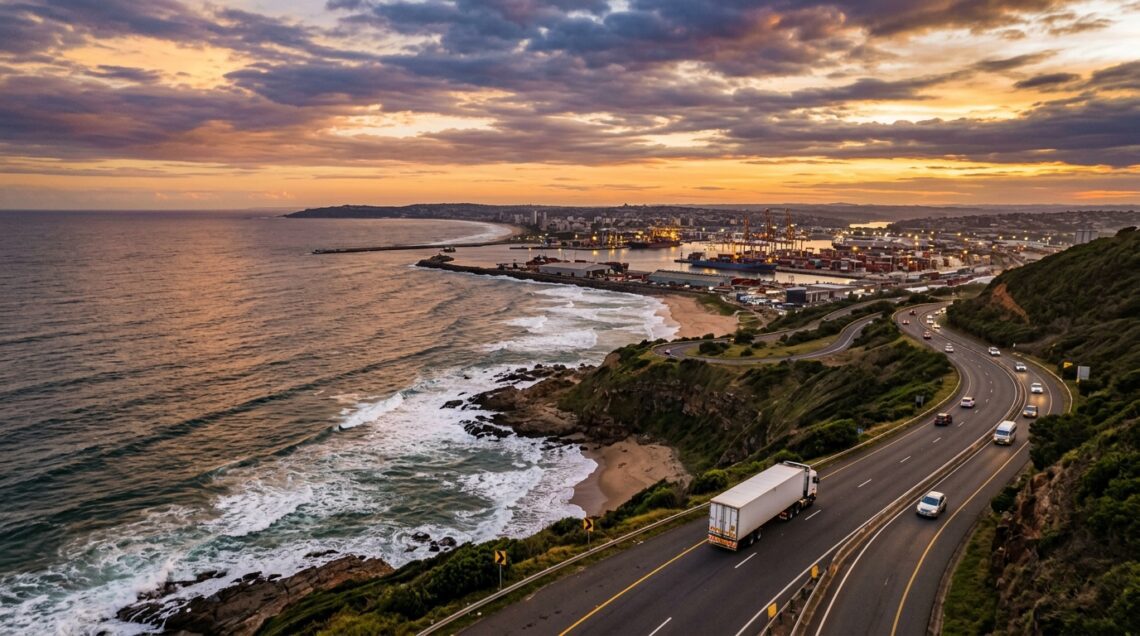
Government’s multi-billion rand infrastructure programme explicitly identifies cold storage, agro-logistics, and refrigerated transport as priority investment areas. Here’s what operators need to know.
The Eastern Seaboard Is No Longer Just Talk
South Africa’s eastern coastline—historically isolated and underdeveloped—is becoming one of the country’s most significant infrastructure investment zones. For cold chain operators, this isn’t another government announcement to file and forget.
The Eastern Seaboard Development (ESD) initiative is a multi-government, multi-sectoral programme spanning the Eastern Cape and KwaZulu-Natal coastline. Unlike previous development promises for the Wild Coast region, this one has concrete infrastructure already rising from the landscape. Parliamentary oversight visits in March 2025 confirmed active construction at mega-bridge sites, with steel deck segments being transported from Mpumalanga and assembled on-site.
More significantly for our industry: government officials have explicitly identified warehousing and cold-storage, agro-logistics platforms, cold-chain systems for export markets, and refrigerated fleet services as priority investment areas. This level of specificity is unusual—infrastructure announcements rarely mention cold chain directly, suggesting genuine understanding of what agricultural export development requires.
The November 2025 Pre-Investment Summit in Mthatha brought together national ministers, two provincial premiers, traditional leaders, and potential investors to map implementation. Minister Velenkosini Hlabisa announced establishment of a special-purpose vehicle and investment facilitation task team to streamline approvals and accelerate deal-making.
This article analyses what the ESD means for cold chain operators, identifies specific opportunities with realistic timelines, and assesses the challenges that will determine which operators succeed in this emerging corridor.
Understanding the Eastern Seaboard Development Initiative
Geographic Scope and Governance
The ESD corridor spans four districts and 17 municipalities across KwaZulu-Natal and the Eastern Cape. Key focus areas include OR Tambo District, Alfred Nzo District, and the Wild Coast corridor, with Port St Johns and Coffee Bay designated as future smart, sustainable regional development nodes.
The initiative builds on the long-established Wild Coast Corridor Development programme, preserving years of planning, community engagement, and infrastructure investment already underway. This integration matters—it means the ESD isn’t starting from zero but accelerating existing momentum.
Governance involves joint planning between Eastern Cape and KwaZulu-Natal provincial governments, aligned with the District Development Model. The programme connects to national frameworks including the National Development Plan 2030, the African Continental Free Trade Area (AfCFTA), and the government’s Economic Reconstruction and Recovery Plan.
Deputy Minister Dr Dickson Masemola emphasised the importance of unified leadership to ensure the Eastern Seaboard does not become a “dream deferred”—an acknowledgment that previous Wild Coast development initiatives stalled despite good intentions.
Why This Initiative Is Different
The Wild Coast has seen multiple development programmes announced over decades with limited implementation. What distinguishes the ESD:
First, major infrastructure is actually under construction. The Msikaba and Mtentu bridges are physically rising over river gorges, with a March 2025 Parliamentary Portfolio Committee visit confirming active construction progress. Steel deck segments are being fabricated and installed. This isn’t planning—it’s building.
Second, significant capital is committed. Package 4 of the N2 Wild Coast Road (Lingeni to Msikaba Bridge) is valued at R2.2 billion. Package 5 (Msikaba to Mtentu) represents R2.5 billion. The Umzimvubu Dam has R8 billion allocated. These aren’t aspirational figures—they’re contracted amounts with construction underway.
Third, cross-provincial coordination structures exist. The joint Eastern Cape–KwaZulu-Natal planning framework, combined with CoGTA oversight, creates accountability that single-province initiatives lacked.
Cold chain operators should approach with cautious optimism: infrastructure is genuinely being built, but realistic timelines extend to 2028 and beyond for full corridor operation.
Infrastructure Progress: What’s Actually Being Built
N2 Wild Coast Highway and Mega-Bridges
The N2 Wild Coast Road project will reduce travel distance between Durban and East London by 85 kilometres and cut transit time by up to three hours. For refrigerated transport, this transforms route economics along the eastern seaboard.
The project comprises seven major construction packages plus two mega-bridges. Current status as confirmed by SANRAL and Parliamentary oversight:
- Msikaba Bridge is a 580-metre cable-stayed structure that will become the longest main span cable-stayed bridge on the African continent, second only to the Maputo-Catembe suspension bridge in Mozambique. The deck will sit 194 metres above the valley floor, making it the third-highest bridge in Africa. Construction of the bridge deck was anticipated to conclude in Q1 2025, with cable installation expected within the same period. The project experienced some delays due to cable unavailability in the local market requiring overseas imports, plus engineering complexity challenges. To date, the contract has created opportunities for 44 local suppliers, 48 service providers, and 61 subcontractors valued at R665.6 million.
- Mtentu Bridge will be a 1.13-kilometre structure including a 260-metre main span—one of the longest balanced cantilever bridges in the world. At 223 metres above the river valley, it will become the highest bridge in Africa and the southern hemisphere, displacing the Bloukrans Bridge. The 141-metre Pier No. 9 will be the tallest bridge pier in Africa. The Parliamentary committee visited the Pier 1 construction site on the north side of the Mtentu River in March 2025, confirming active work.
- Package 4 (N2 Section 20 from Lingeni Intersection to Msikaba Bridge, 17.6 km) is valued at R2.2 billion and awarded to WBHO-Edwin Construction Joint Venture. Construction was scheduled to commence mid-May 2025 following a court interdict being lifted. The project is estimated at 54 months duration, creating 400 jobs valued at R176 million. Contract Participation Goals allocate R700 million (35% of contract value) for local targeted enterprises.
- Package 5 (Msikaba Bridge to Mtentu Bridge, 17 km) is valued at R2.5 billion, awarded to WBHO-H&I Joint Venture. Construction commenced February 2023 with completion anticipated January 2028. As of February 2025, expenditure reached R854 million with 35% physical progress achieved. Contract Participation Goals include R769 million for targeted enterprises, plus R8 million for community development projects.
Cold Chain Implications: Upon completion, the upgraded N2 will support heavier freight vehicles with more frequent traffic. Premier Mabuyane explicitly identified that the corridor supports opportunities for freight and logistics centres, warehousing and cold-storage, air-cargo handling linked to Mthatha Airport, and fleet expansions and intermodal transfer points.
Mthatha Airport Upgrade
The ongoing Mthatha Airport upgrade aims to support both freight and passenger mobility. While specific capacity targets and completion timelines aren’t yet published, the airport’s location adjacent to the Wild Coast SEZ creates natural synergies for air-cargo cold chain operations.
Potential applications include high-value agricultural exports (macadamia, avocados), pharmaceutical distribution to remote healthcare facilities, fresh seafood export, and temperature-controlled courier services connecting the corridor to national networks.
Umzimvubu Dam Project
The Umzimvubu Water Project is one of South Africa’s most strategic integrated water infrastructure investments, with R8 billion allocated. The project has been in planning since 1962 but is now finally progressing.
The project includes Ntabelanga Dam on the Tsitsa River with approximately 490 million cubic metres storage capacity and a 7MW hydropower plant, plus Laleni Dam downstream with approximately 232 million cubic metres storage and both a 6.7MW plant at the dam and a 45MW hydropower station via pipeline/tunnel.
Current status: access roads are substantially complete, with dam construction at approximately 6% as of early 2024, with completion expected in 2028. Minister Pemmy Majodina confirmed in December 2024 that plans to build the dam are at an advanced stage and will ensure sufficient water supply for Alfred Nzo and OR Tambo District Municipalities.
Cold Chain Relevance: Water availability is essential for food processing facilities. Irrigation expansion will increase agricultural production requiring cold chain infrastructure. Industrial parks planned around bulk-water nodes provide potential cold storage locations. Hydropower generation adds to regional energy security—critical given South Africa’s grid instability challenges.
Energy Infrastructure
Energy security is explicitly identified as vital for successful ESD realisation. Feasibility studies show strong onshore wind and solar PV potential across OR Tambo and Alfred Nzo Districts.
Investment opportunities include utility-scale solar and wind farms (10–100MW), hybrid solar-wind-BESS projects to stabilise supply, and municipal renewable energy partnerships. The Matatiele Solar and Baziya Wind initiatives are being packaged into full business cases.
KwaZulu-Natal’s contribution includes wind farms in uMzimkhulu and hydropower development in Greater Kokstad, adding to regional energy capacity.
For cold chain operations, this matters enormously. Load shedding affects the entire corridor, and any cold storage or processing facility requires reliable power with backup systems. New facilities can potentially integrate renewable energy from inception, while battery storage systems align naturally with cold storage backup power requirements.
Wild Coast Special Economic Zone: Cold Chain at the Core
The Wild Coast SEZ represents the most concrete cold chain opportunity within the ESD framework. Located adjacent to Mthatha Airport, the approximately 95-hectare industrial park is being implemented in phases with the Coega Development Corporation as implementing agent.
Investment Progress
Four investment projects were signed between 2020 and 2021 with a combined value of R1.07 billion and 968 operational jobs expected. Key industries are agro-processing and manufacturing, with CDC currently negotiating with additional investors.
Planned Facilities with Direct Cold Chain Requirements
The SEZ development includes specific facilities that will require temperature-controlled infrastructure:
- An essential oil processing facility will handle temperature-sensitive botanical extracts
- A logistics and distribution facility will serve as a regional hub
- Maize storage facility and silos will require climate control for grain preservation
- A maize milling facility will be designed considering existing mills in the area
- A dairy processing facility with warehousing will need chilled storage and cold distribution capability
- A wool sourcing facility including sorting and classing operations will require controlled environments
- A shared administrative and services facility will support multiple tenants
- A multi-user agro-processing incubator aimed at similar and seasonal producers will need flexible cold storage access
Anchor Value Chains
The SEZ application for official designation focuses on agro-processing, tourism, and green industries. Anchor value chains identified include sub-tropical and citrus fruit, essential oils, cash crops (maize, beans), tea from the Magwa-Majola valley, and red meat processing.
Each of these value chains has specific cold chain requirements—from +2°C to +8°C for fresh citrus to -18°C for frozen meat products.
Development Status and Timeline
The SEZ is officially “under development”—not yet fully operational. Fast-tracking has been announced but specific timelines remain unclear. This represents an early engagement opportunity for cold chain infrastructure providers willing to participate in facility planning rather than arriving after construction.
The King Sabata Dalindyebo Municipality is partnering with DICLA Training and Projects to capacitate people with farming and agricultural skills, preparing the workforce for SEZ operations.
Cold Chain Opportunities Explicitly Identified by Government
Premier Mabuyane’s address to the Pre-Investment Summit contained unusually specific cold chain references that warrant direct attention from operators.
Direct Government Mentions
The upgraded N2 corridor explicitly supports opportunities for warehousing and cold-storage. Agro-logistics platforms and cold-chain systems for export markets are identified as agricultural development priorities. Refrigerated fleet leasing and coastal logistics services feature in the ocean economy development plans. Air-cargo handling linked to Mthatha Airport suggests temperature-controlled freight capability.
Agricultural Cold Chain Demand
High-value crops identified for development each carry specific temperature requirements:
- Macadamia nuts require +2°C to +8°C storage with humidity control, commanding high export value to Asian and European markets
- Avocados are highly temperature-sensitive with significant export market potential
- Citrus has established cold chain protocols and represents the Eastern Cape’s largest agricultural export sector
- Essential oils require controlled temperature storage for quality preservation
- Cannabis for medicinal extracts demands pharmaceutical-grade cold chain compliance
The Magwa-Majola Tea and Eco-Tourism Valley development adds processing and beneficiation opportunities. Traditional agriculture including meat, dairy, grain, and wool processing will require temperature-controlled facilities throughout the value chain.
Fisheries and Ocean Economy
The Eastern Cape ocean economy contributed R27.9 billion to provincial GDP in 2023 and supports 43,000 jobs. The ESD includes specific fisheries development:
- Port St Johns small harbour development will create landing and processing infrastructure requiring ice production and cold storage
- Aquaculture expansion demands controlled-temperature processing facilities
- Marine transport and small vessel operations need ice and refrigeration support
- Coastal logistics services will distribute fresh and frozen seafood to inland markets
Government emphasises strict environmental and regulatory compliance, including marine licensing, aquaculture permitting, and coastal management—suggesting export-grade operations will require proper certification from inception.
Tourism and Hospitality
Development nodes including Port St Johns Waterfront, PSJ Second Beach redevelopment, Wild Coast Meander Tourism Corridor, eco-lodges, and the Silaka Restaurant and Conference Centre redevelopment will all generate cold chain demand:
- Hotels and lodges require reliable food service supply chains
- Restaurants in remote locations need temperature-controlled distribution
- Event catering logistics must serve venues with limited existing infrastructure
- Fresh produce distribution to tourism nodes creates last-mile delivery opportunities
Market Context: Major Cold Chain Investment Already Underway in Eastern Cape
The ESD corridor doesn’t exist in isolation. Significant cold chain investment is already flowing into the Eastern Cape, establishing infrastructure and competitive dynamics that will shape corridor development.
Commercial Cold Holdings Expansion
African Infrastructure Investment Managers (AIIM), through its Commercial Cold Holdings (CCH) platform, has been aggressively expanding in the Eastern Cape.
In November 2025, AIIM acquired a 70% stake in Port Elizabeth Cold Storage (PECS) in the Coega Port Zone. The acquisition adds approximately 15,000 pallet positions to CCH’s platform, expanding national footprint by 10% and strengthening its position as the largest cold storage platform on the African continent. PECS handles over 200,000 pallets of citrus exports annually—equivalent to approximately 8% of South Africa’s total citrus exports.
Paul Gibbons, CEO of Commercial Cold Holdings, stated that with the addition of PECS, CCH is deepening presence in one of South Africa’s most important agricultural export hubs. The integration strengthens ability to provide end-to-end temperature-controlled logistics and deliver certainty to customers during critical export windows.
Earlier in 2024, CCH completed construction of the Greenbushes facility near Gqeberha—a 7,000-pallet greenfield development representing the first new-build under the CCH platform. The facility uses eco-friendly CO2 refrigeration systems and rainwater harvesting, designed for mixed-use applications including fruit exports, frozen imports, and general bulk storage.
AIIM’s Anyababa Ikem noted that temperature-controlled logistics is vital for improving food security, enabling trade, and creating quality jobs—and that CCH continues exploring further acquisitions and greenfield developments across the continent.
Implications for ESD Corridor
CCH’s Eastern Cape expansion establishes several market realities:
- Major institutional capital (AIIM manages over R34 billion in infrastructure assets) is actively investing in South African cold chain
- The Eastern Cape is recognised as a strategically important agricultural export hub
- Professional cold chain operators are building scale through both acquisitions and greenfield development
- Standards are being set—CO2 refrigeration, renewable energy integration, sustainable operations
For operators considering the ESD corridor, CCH represents either potential competition, potential partnership, or a benchmark for operational standards. The Wild Coast corridor could become an extension of CCH’s Eastern Cape network or an opportunity for alternative operators to establish presence before the major platforms arrive.
National Context: Maersk’s Cape Town Investment
While not directly in the ESD corridor, Maersk’s October 2025 opening of its R1.72 billion Belcon Cold Store in Cape Town signals broader confidence in South African cold chain infrastructure. The 32,000-pallet facility addresses critical gaps in export logistics—Maersk estimates logistics inefficiencies in the grape industry alone cost exporters up to R1.5 billion annually.
This investment demonstrates that global logistics leaders see South Africa’s agricultural export sector as worth substantial capital commitment. Similar logic could eventually apply to the Eastern Cape corridor as infrastructure matures.
KwaZulu-Natal Component: Southern Coastal Integration
The ESD isn’t only an Eastern Cape initiative. KwaZulu-Natal’s southern coastal region forms an integral part of the corridor, with its own catalytic projects announced by MEC Rev. Thulasizwe Buthelezi.
Catalytic Projects
- Wind farms in uMzimkhulu add renewable energy capacity to the southern corridor
- Hydropower development in Greater Kokstad contributes to regional energy security
- The Kokstad interchange improves road connectivity between coastal and inland routes
- Road upgrades throughout the southern KZN corridor improve freight access
- Small craft harbours in Port Shepstone and Hibberdene create seafood landing and distribution nodes
Cold Chain Relevance
The Port Shepstone and Hibberdene harbours will require ice production, cold storage, and refrigerated distribution capability for fishing industry support. Improved road infrastructure enables refrigerated transport connections between KZN coastal facilities and inland markets. Energy projects (wind, hydro) improve power reliability for temperature-controlled operations.
Cross-Provincial Integration
The ESD framework enables joint planning between Eastern Cape and KZN governments, potentially creating seamless cold chain corridors from Durban through the Wild Coast to East London. This integration could support regional cold chain networks serving both provinces, hub-and-spoke models with coastal processing and inland distribution, and cross-border logistics positioning as AfCFTA implementation progresses.
For operators, this means planning should consider the full corridor rather than isolated provincial opportunities.
Realistic Assessment: Challenges and Timelines
Understanding what’s actually achievable—and when—separates strategic positioning from premature investment.
Infrastructure Completion Timelines
Based on confirmed project schedules:
- Msikaba Bridge deck and cables were expected Q1 2025, though delays have occurred. Final completion timing should be verified with SANRAL
- Mtentu Bridge is scheduled for 2025 completion, creating the highest bridge in Africa
- Package 5 road (connecting the bridges) has a contracted completion date of January 2028
- Package 4 road commenced May 2025 with 54-month duration, suggesting completion around 2029-2030
- Umzimvubu Dam construction completion is expected 2028
- Wild Coast SEZ remains in development phase with no published operational date
What This Means Practically
The full N2 corridor won’t be operational until late 2020s. Individual sections will open progressively, but the transformative “85 km shorter, 3 hours faster” benefit requires complete construction. Cold chain infrastructure investment should align with these timelines.
Operational Challenges
Current cold chain presence along the Wild Coast corridor is minimal. There are no major cold storage facilities between East London and Durban via the existing N2. Refrigerated transport operators serving the region are limited. Service infrastructure (maintenance, fuel, parts) is underdeveloped.
Skills availability presents challenges. Government has emphasised TVET college integration to build workforce capability, but current refrigeration technician availability in the region is limited. Any operator establishing presence will need training programme investment.
Power reliability affects the entire corridor. Until renewable energy projects reach operational status, grid instability requires robust backup systems for any cold chain facility. This adds capital cost and operational complexity.
Road conditions between infrastructure completion points remain challenging. Seasonal conditions affect reliability, and vehicle maintenance costs are higher on current roads than established routes.
Realistic Operator Timeline
Based on infrastructure schedules and market development:
- 2025–2026: Monitor infrastructure progress. Identify partnership opportunities with government and local stakeholders. Begin regulatory engagement and site assessment. Build relationships with SEZ development authorities and municipal economic development offices.
- 2027–2028: Early infrastructure sections become operational. Pilot operations possible in developed nodes (Mthatha, Port St Johns). Equipment and facility planning based on confirmed demand. Training programme development for local workforce.
- 2029 onwards: Full corridor operations as N2 construction completes. SEZ cold chain infrastructure operational. Regional network establishment connecting coastal and inland facilities. Integration with established Eastern Cape cold chain operators.
Risk Factors
Government implementation risk remains real. South Africa has a history of announced projects not reaching completion. Political changes affect project prioritisation, and funding constraints may cause delays. The Parliamentary oversight visits and active construction provide confidence, but vigilance is warranted.
Market development takes time. Agricultural production scaling, export market development, and tourism growth all depend on factors beyond infrastructure alone. Cold chain demand will grow with the broader economy, not ahead of it.
Competition may intensify. Established operators from Durban and East London will expand as opportunities emerge. National platforms like CCH are actively acquiring and building. First-mover advantage requires actual movement, not just monitoring—but moving too early creates stranded asset risk.
Opportunities by Operator Type
Cold Storage Facility Developers
The Wild Coast SEZ offers greenfield development opportunity with government support, potentially including SEZ incentives. Multi-temperature facilities serving agriculture (citrus, avocado, macadamia) and fisheries (fresh and frozen seafood) address identified demand. Strategic locations at transport nodes (Mthatha adjacent to airport and SEZ, Port St Johns as coastal hub) align with infrastructure investment.
Key considerations: Development timelines should align with infrastructure completion and market development. Community partnership requirements are emphasised across all ESD documentation. Power backup systems are essential given current grid reliability. Plan for 5+ year development horizons.
Refrigerated Transport Operators
Regional distribution from established hubs (Durban, East London, Gqeberha) can serve emerging corridor demand as infrastructure improves. Last-mile delivery to tourism and hospitality clients in remote locations addresses a service gap. Agricultural collection and consolidation services connecting smallholder farmers to processing facilities align with SEZ and government priorities.
Key considerations: Vehicle specifications must handle current road conditions until N2 completion. Routes are longer than typical urban operations—thermal load planning is critical. Service infrastructure (maintenance, parts, fuel) along the corridor is limited. Partnership with emerging SEZ operations could provide anchor business.
Equipment Suppliers
New facility construction at the SEZ and elsewhere will require refrigeration systems across temperature ranges. Transport operators entering the corridor need vehicles and transport refrigeration units. Monitoring and compliance technology supports export-grade operations meeting international standards.
Key considerations: Service and support infrastructure in the region needs development—this is both challenge and opportunity. Training and skills transfer create long-term customer relationships. Local assembly or manufacturing partnerships may align with government localisation priorities.
Compliance and Consulting Services
Export certification support for EU, UK, and Asian markets will be essential as agricultural exports scale. HACCP and food safety system implementation supports processing facilities. GDP compliance capability addresses pharmaceutical distribution potential. Training programme development fills identified skills gaps.
Key considerations: Market development is required—current operators in the region are often informal. Government partnership opportunities exist through TVET integration emphasis. Building relationships with emerging operators creates long-term advisory roles.
How to Position for ESD Opportunities
Monitoring and Intelligence
Track CoGTA announcements on ESD implementation and special-purpose vehicle establishment. Follow SANRAL progress updates on N2 construction packages and bridge completion. Monitor Eastern Cape and KZN provincial government infrastructure announcements. Watch Coega Development Corporation updates on Wild Coast SEZ tenant progress.
Industry publications including Engineering News, Cold Link Africa, and Farmer’s Weekly provide ongoing coverage of relevant developments.
Stakeholder Relationships
Government engagement should target district municipality economic development offices in OR Tambo and Alfred Nzo, provincial departments of agriculture and rural development, and trade and investment promotion agencies including ECDC and Coega.
Community engagement is emphasised throughout ESD documentation. Traditional leadership consultation is explicitly required. Local business chamber participation builds regional presence. Skills development partnership opportunities align with government TVET priorities.
Practical Preparation
Conduct route surveys as N2 sections complete to understand actual operating conditions. Assess power infrastructure at potential facility sites, including renewable energy and backup options. Analyse labour markets for regional operations, identifying training requirements. Model financial scenarios across different timeline assumptions.
Conclusion
The Eastern Seaboard Development represents genuine opportunity for cold chain operators willing to take long-term positions. Unlike many government announcements, the ESD has concrete infrastructure under construction—Parliamentary oversight has confirmed active building at mega-bridge sites, with billions of rands in contracted work progressing through defined timelines.
Government explicitly identifies cold storage, agro-logistics platforms, and refrigerated transport as priority investment areas. The Wild Coast SEZ has specific facilities planned that require temperature-controlled infrastructure. Major institutional investors like AIIM are already expanding cold chain capacity in the Eastern Cape, validating the region’s strategic importance.
However, this is not a 2025 opportunity—it’s a 2028+ reality. The N2 corridor won’t be fully operational until late this decade. The SEZ remains in development. Agricultural production and export markets need time to scale. Operators rushing to establish presence before infrastructure and demand materialise will face the challenges that have limited Wild Coast development for decades: difficult access, unreliable power, limited services, and underdeveloped markets.
The strategic approach: Monitor infrastructure progress through official channels and site verification. Build relationships with government, community, and industry stakeholders now. Prepare operational plans for phased entry as the corridor develops. Consider partnership with established Eastern Cape operators already investing in the region.
First-mover advantages exist in the ESD corridor, but they accrue to operators who time their entry correctly—arriving with infrastructure completion and market development, not years ahead of demand. The cold chain operators who succeed here will be those who combine patience with preparation, entering when conditions support sustainable operations rather than speculative positioning.
The Eastern Seaboard will transform South Africa’s eastern coastal economy over the coming decade. Cold chain infrastructure will be essential to that transformation. The question for operators isn’t whether to engage—it’s when and how.
Sources & References
Government Sources
- Premier Oscar Mabuyane: Profiling Investment Opportunities in Eastern Seaboard Development Region Programme – Remarks delivered at Dan’s Country Lodge, Mthatha, November 2025. South African Government.
- Remarks by Eastern Cape Premier Lubabalo Oscar Mabuyane at the Profiling Investment Opportunities in the Eastern Seaboard Development Region Programme – Department of Cooperative Governance and Traditional Affairs, November 2025.
- Minister Velenkosini Hlabisa addresses strategic Pre-Investment Summit engagement on Eastern Seaboard Development (ESD) corridor – South African Government media statement, November 2025.
- Hlabisa calls for partnerships to transform the Eastern Seaboard economy – SAnews.gov.za, November 2025.
- Report of the Portfolio Committee on Transport on Its Oversight Visit to SANRAL, 25–28 March 2025 – Parliamentary Monitoring Group, June 2025. Confirms N2 Wild Coast Road construction progress and site visits.
- Bulk water project signals new chapter for Eastern Cape communities – SAnews.gov.za, December 2024. Confirms Umzimvubu Dam progress.
- Highlights of the State of the Nation Address 2024 – Infrastructure development – South African Government, February 2024. Lists Umzimvubu among priority water infrastructure projects.
Infrastructure and Construction
- SANRAL announces new R2.2 billion project and Contractor Development Programme for N2 Wild Coast Road – SANRAL Stop Over, August 2024.
- Sanral launches R2.2 billion project along N2 in the Eastern Cape – IOL, August 2024.
- N2 Wild Coast Toll Road megabridge project – Msikaba bridge, South Africa – update – Engineering News, August 2024.
- N2 Wild Coast Toll Road megabridge project – Mtentu bridge, South Africa – update – Engineering News, August 2024.
- Msikaba Bridge – Wikipedia. Technical specifications and construction status.
- Msikaba Bridge – HighestBridges.com. Bridge specifications and African records.
- Mtentu Bridge – HighestBridges.com. Bridge specifications confirming highest bridge in Africa status.
Special Economic Zone
- Wild Coast SEZ Progressing Well with 1,000 Estimated Jobs on the Cards – King Sabata Dalindyebo Municipality, 2023. Details R1.07bn investment and planned facilities.
- Wild Coast economic zone has attracted investment of R1.07bn so far – Dispatch Live, April 2023.
- Special Economic Zone planned for the Wild Coast – Global Africa Network, July 2022.
- Special Economic Zones – Department of Trade, Industry and Competition. National SEZ overview.
Cold Chain Industry
- AIIM expands Africa’s largest cold-storage platform with acquisition of Port Elizabeth Cold Storage – AIIM, November 2025. Details 70% stake acquisition and 15,000 pallet capacity.
- AIIM acquires 70% stake in Port Elizabeth Cold Storage – Engineering News, November 2025.
- AIIM acquires majority stake in Port Elizabeth Cold Storage – Fresh Plaza, November 2025.
- AIIM boosts export infrastructure with construction completion of new cold storage facility – AIIM, September 2024. CCH Greenbushes 7,000-pallet facility.
- New Cold Storage Facility Strengthens Logistics in the Eastern Cape – Commercial Cold Holdings, February 2025.
- Maersk set to boost Cape exports with R1.7bn cold storage hub – Moneyweb, October 2025.
Regional Context and News Coverage
- Eastern seaboard project a chance to create opportunities for all – Daily Dispatch, December 2025. Premier Mabuyane opinion piece.
- Minister Hlabisa Champions Bold Partnerships to Transform Eastern Seaboard into Economic Powerhouse – Central News South Africa, November 2025.
- Minister Hlabisa Unveils New Eastern Seaboard Growth Drive – Pondoland Times, November 2025.
- Premier Mabuyane Backs Eastern Seaboard Investment Push – Pondoland Times, November 2025.
- 2024 Regional Overview of the Eastern Cape Province – South African Business, June 2024.
About ColdChainSA
ColdChainSA is South Africa’s specialised cold chain industry directory, built by operators who understand temperature-controlled logistics. We connect businesses with qualified service providers across transport, storage, equipment, and compliance services throughout South Africa.
Our coverage includes the Eastern Cape region, where we track industry developments and maintain listings of cold chain operators serving Gqeberha, East London, and emerging corridors.