
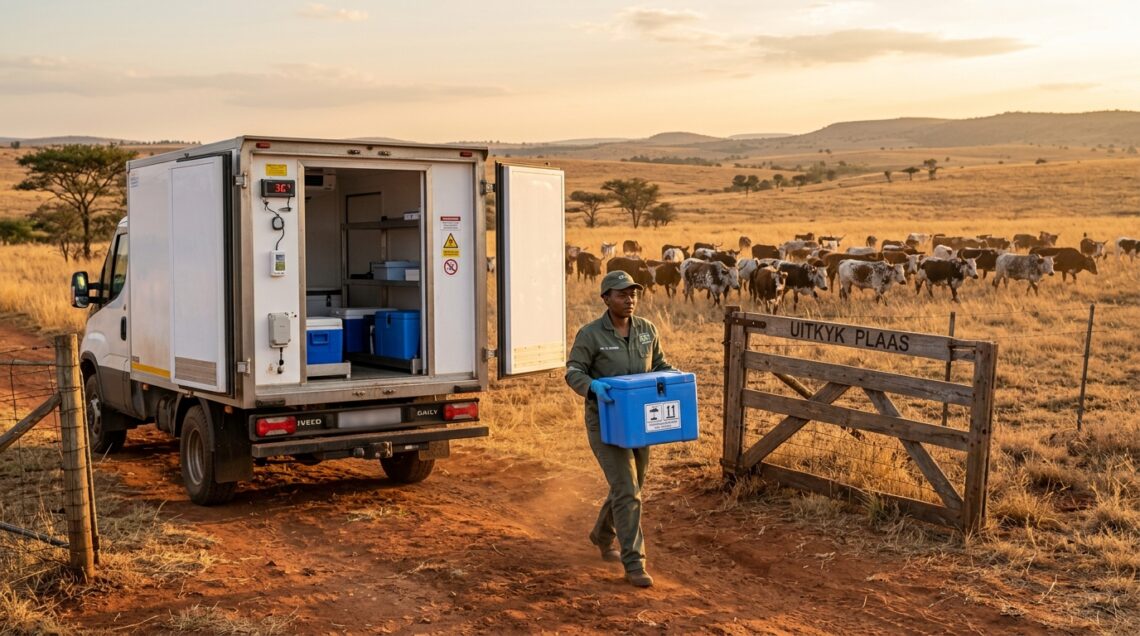
When the Vaccines Arrived — and the Cold Chain Wasn’t Ready
South Africa imported 1.5 million doses of FMD vaccine from Turkey. A specialist cold chain logistics company flew them into OR Tambo on temperature-controlled air freight, cleared customs, and delivered them to a validated cold storage facility in Johannesburg under GDP-compliant conditions with real-time temperature monitoring throughout.
That part worked.
Then government handed those doses to the provincial veterinary distribution system — and the documented, auditable cold chain effectively ended.
What happened next is not a story about a disease. It is a story about what happens when pharmaceutical-grade logistics meets a veterinary distribution infrastructure that was not built for it, governed by a legal framework that hadn’t been gazetted, coordinated through provincial structures that were giving farmers contradictory information, and deployed into rural areas where the last kilometres to the farm gate are the hardest in the world to keep cold.
South Africa’s FMD crisis is the largest animal health cold chain operation this country has ever attempted. The industry delivered the vaccines. The system failed to move them.
The Scale of What Was Attempted
To understand why the cold chain matters here, you need to understand the scale of the logistical task.
Foot-and-mouth disease is a controlled animal disease under the Animal Diseases Act 35 of 1984. It is highly contagious, economically devastating, and — critically for export markets — classified by the World Organisation for Animal Health (WOAH) in a way that immediately triggers trade bans from importing countries. China banned South African beef in May 2025 when the current outbreak escalated. That ban remains in place.
The outbreak has spread across eight of South Africa’s nine provinces since mid-2025. By the end of January 2026, FMD was confirmed active in KwaZulu-Natal, Gauteng, Limpopo, Mpumalanga, the Free State, North West, the Eastern Cape, and the Western Cape. In Gauteng alone, 228 confirmed cases were recorded across 297,413 animals by late February 2026. The national herd numbers approximately 12 million cattle.
The government’s stated target: vaccinate 80% of the national herd by December 2026. That is roughly 9.6 million animals. The vaccine campaign requires multiple doses per animal at defined intervals.
The economic stakes are not abstract. Beef contributes approximately R46 billion to South Africa’s farm economy. Dairy adds another R22 billion. Together with poultry, livestock accounts for roughly half of total agricultural output. The R80 billion livestock sector is the productive base of rural livelihoods across multiple provinces.
This is not a niche agricultural problem. It is a national food system crisis — and the cold chain is the operational backbone of the response.
What the Vaccine Requires
FMD vaccines are inactivated, oil-adjuvanted biological products. The Dollvet-Oil formulation used in the first large import batch is a trivalent double W/O/W (water-in-oil-in-water) emulsion vaccine matched to South Africa’s SAT 1, SAT 2, and SAT 3 serotypes.
This formulation has one non-negotiable cold chain requirement: continuous storage at +2°C to +8°C from manufacturing through to administration.
It must not be frozen. Freezing destroys the emulsion structure of oil-adjuvanted vaccines irreversibly, rendering them ineffective. It must not be allowed to warm above +8°C for extended periods, as heat accelerates potency degradation in inactivated antigens. There is no visual indicator that a compromised vaccine has failed — it looks identical to a functional one.
Research published in PMC from a field study in Cambodia demonstrated directly that cold chain breakdown in FMD vaccination campaigns produces vaccine failure: more than half of cattle vaccinated with improperly stored FMD vaccines in that study subsequently showed clinical signs of infection. The vaccine had been administered — the animals simply had no protection.
In South Africa’s Gauteng, at an altitude of approximately 1,700 metres, summer ambient temperatures regularly exceed 35°C. In KwaZulu-Natal coastal communal farming areas, humidity and temperature conditions are extreme. In the Northern Cape and Free State in summer, vehicle cabin temperatures without active refrigeration can exceed 50°C within 30 minutes in direct sun.
The cold chain requirement of +2°C to +8°C is not a bureaucratic specification. It is the difference between a functional vaccine and an expensive placebo.
The Import Leg: Where It Worked
South Africa’s logistics sector handled the international import operation with demonstrable competence.
DSV Air & Sea managed the 1.5 million dose Dollvet-Oil shipment from Turkey on behalf of Dunevax Biotech. The consignment landed at OR Tambo International Airport on 1 March 2026 on temperature-controlled air freight. DSV operated from its facility at OR Tambo, using validated cold rooms, real-time temperature monitoring systems, and GDP-compliant handling procedures throughout customs clearance and cargo handling.
Fritz Rexrodt, director of Dunevax, confirmed the operation achieved full compliance and temperature integrity from arrival through to release. Melanie Smit, Vice President of DSV Air & Sea Sub-Saharan Africa, described the delivery as an important milestone in South Africa’s response to the ongoing FMD outbreak.
The Agricultural Research Council, which had restarted domestic FMD vaccine production for the first time in 20 years, released an initial batch of 12,900 doses in February 2026 for hotspots in the Eastern Cape, scaling toward 20,000 doses per week from March 2026 and targeting 200,000 per week by 2027. Separately, the government had received one million doses from Biogénesis Bagó in Argentina, with further consignments scheduled.
The supply side, in short, worked. Vaccines arrived under cold chain. The problem was what happened next.
The Distribution Gap: Where It Failed
Once vaccines move beyond the primary approved cold storage facility in South Africa, they enter the provincial veterinary distribution network. This is where the documented cold chain ends — and where the problems begin.
The Ministerial Task Team on Controlled Animal Diseases, in minutes from its 17 March 2026 meeting subsequently filed in court proceedings, identified a problem that had received almost no public attention: the diagnostic system had collapsed. Provincial veterinary services were reporting waits of months for confirmation of circulating FMD virus strains from the Agricultural Research Council. Task team members described this as a “critical system risk.” Without timely diagnostic feedback on which strains are actually circulating where, vaccine deployment cannot be strategically targeted. The programme defaults to blanket coverage — which wastes cold storage capacity, strains distribution logistics, and may miss active outbreak zones.
The coordination failures went further than diagnostics.
On 20 February 2026, the FMD Industry Coordination Council reported that some Provincial State Veterinarians had required producers to sign an application and indemnity form before their herds could be vaccinated. This form was subsequently confirmed to have been circulated in error. The Deputy Director-General formally withdrew it. Farmers who had been refused vaccination while awaiting this form had lost weeks in a campaign where timing directly affects containment.
There was no single, authoritative communication channel. The Gauteng MEC for Agriculture and Rural Development announced a live geomap platform to give farmers real-time data on the outbreak and vaccination rollout — but when asked at a 26 February 2026 media briefing when this tool would go live, said: “I’d be reluctant to give you a date, but suffice to say it is also very urgent.” A WhatsApp channel was created as an interim measure.
Francois Rossouw, CEO of the Southern African Agri Initiative (SAAI), described the gap directly: “There is a massive communication gap. Farmers are left in the dark — they often don’t know what is going on.”
AfriForum’s Lambert de Klerk stated that communication throughout the crisis could have been more consistent, more timely, and more transparent.
In this information vacuum, exploitation followed. The FMD Industry Coordination Council flagged in a 13 February 2026 progress report that certain individuals and companies were circulating messages on farmer communication groups encouraging farmers to register on private websites to secure access to FMD vaccines — in some cases requesting upfront payments. No private entity had the authority to secure or distribute FMD vaccines outside of approved government processes.
The Legal Framework That Wasn’t There
Here is the problem that sits underneath all of it, and that the cold chain industry needs to understand clearly.
Under the Animal Diseases Act 35 of 1984, FMD is a controlled animal disease. The legal framework for mass vaccination — including who can administer vaccines, how distribution is authorised, and what accountability structures govern the cold chain — requires a formal scheme to be published under Section 10 of that Act.
That scheme was never gazetted.
In January 2026, a Section 10 scheme was expected to be finalised by the end of the month. It was not. As the FMD Industry Coordination Council noted when the National Disaster was classified in February 2026: farmers, feedlots, and dairies could not legally conduct independent pre-emptive vaccination “unless and until the Minister enacts a scheme under Section 10 of the Animal Diseases Act and the necessary notices are gazetted.”
The absence of a gazetted scheme meant that the distribution of vaccines was occurring without the formalised legal architecture that would define accountability at each point in the chain.
The matter reached the courts. Sakeliga, the Southern African Agri Initiative, and Free State Agriculture brought an application before the North Gauteng High Court. On 24 March 2026, the court ordered the Minister of Agriculture to promulgate and publish the national animal health scheme for FMD in the Government Gazette by no later than 17 April 2026 — in terms of Section 10 of the Animal Diseases Act or other relevant regulations.
The court held the Minister of Agriculture, the Director General, and the Director: Animal Health jointly and severally liable for wasted costs — on Scale C, including two counsel where employed. The matter was postponed to 28 April 2026. Farmer’s Weekly submitted questions to government on vaccine procurement, diagnostic turnaround times, policy alignment, and surveillance coordination. No answers were provided.
The national FMD vaccination programme operated for months without a gazetted legal framework. During that period, the cold chain accountability chain was similarly undocumented.
What This Reveals About Veterinary Cold Chain in South Africa
The FMD crisis has exposed a structural reality that cold chain operators and logistics businesses serving the agricultural and pharmaceutical sectors need to understand.
Commercial cold chain infrastructure and government veterinary distribution infrastructure are not the same thing — and the gap between them is substantial.
South Africa’s commercial cold chain can deliver pharmaceutical-grade biologicals from Ankara to OR Tambo with full temperature traceability and GDP compliance. This is demonstrated fact.
What does not exist, in documented and auditable form, is an equivalent standard for the final distribution leg: from the approved cold storage facility to the provincial depot, from the depot to the field veterinary team, and from the field veterinary team to the farm — especially in communal farming areas where electricity is intermittent, access roads are unpaved, and the ambient temperature at the point of administration may be 38°C.
The same cold chain science that applies to a pharmaceutical shipment applies to an FMD vaccine in a cooler bag in the back of a state veterinary vehicle in the Zululand communal areas. But the documentation, equipment standards, monitoring requirements, and accountability structures are entirely different.
The World Organisation for Animal Health guidelines on FMD vaccination require that vaccine administration be part of a “centrally managed, technically rigorous programme.” The emphasis on technical rigour applies as much to cold chain management as to strain selection and dosage.
Research from veterinary science literature is unambiguous: cold chain breakdown in FMD vaccination campaigns directly causes vaccine failure. An animal can be correctly identified, correctly dosed at the correct interval, and receive a vaccine that never conferred immunity — because the cold chain broke somewhere between the depot and the farm, invisibly, with no monitoring to detect it.
The Budget Reality
Provincial governments have begun ring-fencing funds for the response. Gauteng allocated R63.9 million for FMD vaccination and surveillance in its 2026/27 budget — approximately 8.6% of the provincial Department of Agriculture’s total budget. The province had already redirected R16 million internally before the formal allocation to procure the Botswana Vaccine Institute (BVI) vaccine and necessary equipment.
The Western Cape ring-fenced R139.7 million from its provincial budget for unforeseen and unavoidable events — earmarked specifically for vaccines and scaling provincial veterinary capacity to protect the dairy and meat industries.
KwaZulu-Natal, despite having the highest active outbreak burden of any province, did not specify an exact allocation in its provincial budget speech, with the MEC describing FMD only as an “emerging crisis.”
Cold storage capacity, temperature monitoring equipment, refrigerated vehicles for field distribution, and the trained personnel to operate them are not free infrastructure items. They require budget line items that do not appear to have been consistently planned or allocated before the crisis escalated.
What Cold Chain Operators Can Learn
The FMD vaccine rollout is a case study in what happens when a mass cold chain logistics operation is attempted without the right foundations in place.
- No gazetted legal framework defining accountability at each distribution node. The absence of a Section 10 scheme meant there was no formal document defining who owns cold chain integrity between the national depot and the farm. Without defined accountability, there is no mechanism to measure compliance or assign liability when the chain breaks.
- Inadequate cold storage infrastructure at provincial depot level. The commercial logistics sector delivered to a primary approved facility. What that facility feeds into — the provincial depot network — was not designed, resourced, or equipped for the volume and temperature sensitivity of a national mass vaccination programme operating simultaneously across eight provinces.
- No temperature monitoring for the last mile. Real-time temperature monitoring governed the OR Tambo import operation. There is no evidence of equivalent monitoring discipline applied systematically to the distribution leg from provincial depot to farm. In the absence of monitoring, cold chain breach is invisible until vaccine failure appears.
- Communication infrastructure as part of cold chain design. Cold chain logistics and communication are not separate systems. A farmer who does not know when the veterinary team is arriving cannot prepare animals for vaccination. A veterinary team that cannot confirm which strains are circulating cannot make informed decisions about dosing sequence. A provincial depot that cannot track stock movement cannot manage cold storage capacity. The communication breakdown the FMD response exposed is also, at its root, a logistics failure.
- Private sector cold chain capacity excluded from the formal distribution system. Minister Steenhuisen acknowledged that government’s procurement cost reflects the full operational process required to move vaccines through the national veterinary distribution system. What was not explicitly included was the systematic engagement of private sector cold chain operators — refrigerated transport companies, specialist biologicals distributors, temperature-controlled last-mile logistics — as formal partners in the provincial distribution architecture. This is a structural gap.
The Broader Pattern
This is not a new problem. It is an acute expression of a chronic one.
As documented by agricultural economists including presidential envoy Wandile Sihlobo, South Africa’s animal biosecurity challenges have been compounded for years by fragmented governance, weak coordination between national and provincial authorities, and systemic challenges in vaccine production, procurement, and distribution — specifically including cold chain infrastructure failures and ageing equipment.
The FMD outbreak made this visible at scale, in real time, under conditions where the economic and public health consequences of failure are measured in billions of rand and rural livelihood collapses.
The court order of 24 March 2026 has given the government an immovable deadline: gazette the Section 10 scheme by 17 April 2026. Cold chain accountability — who owns it, how it is monitored, what happens when it fails — needs to be a named component of that scheme, not an afterthought. The matter returns to court on 28 April 2026.
What Needs to Happen
South Africa cannot manage future animal health crises of this scale without a functional veterinary cold chain policy framework. That framework requires at minimum:
- A defined provincial depot infrastructure standard for cold storage of veterinary biologicals, including power backup requirements given load shedding.
- Temperature monitoring requirements for all distribution legs beyond the primary cold storage facility — not just the import operation.
- Formal integration of private sector cold chain operators as distribution partners with defined contractual and quality standards.
- A traceability system that follows the vaccine from primary cold storage to point of administration — not just animal tracking post-vaccination.
- Rapid diagnostic feedback mechanisms from the ARC to field teams, which cannot function without the data infrastructure that a proper distribution system would provide.
These are not aspirational suggestions. They are the minimum conditions for confidence that a vaccine reaching a farm has the potency it was manufactured with.
The logistics industry delivered 1.5 million doses from Ankara to Johannesburg with full cold chain integrity. The question the FMD crisis has now forced onto the table is whether South Africa can match that standard for the last 200 kilometres.
Sources & References
Government and Legal
- National Disaster Declaration — Disaster Management Act No. 57 of 2002 — Dr Elias Sithole, Head of the National Disaster Management Centre, declared FMD a national disaster on 15 February 2026 under Section 23(1)(b) and 23(6) of the Act
- Court order: Sakeliga, SAAI & Free State Agriculture v Minister of Agriculture — North Gauteng High Court, 24 March 2026; Minister ordered to gazette FMD scheme under Section 10 of the Animal Diseases Act by 17 April 2026; matter returns 28 April 2026
- SAnews: Steenhuisen refutes claims of government profiting from FMD vaccines — Official ministerial statement on cold chain and distribution costs in the national vaccination programme
- Polity.org.za: Minister Steenhuisen on the cost of vaccinating the herd against FMD — Full ministerial statement including detail on provincial depot network and cold chain operational requirements
- DA: War on Foot-and-Mouth Disease — Official DA briefing confirming vaccine supply figures, mass vaccination targets, and disease response framework
Industry and News
- Farmer’s Weekly: Confusion, cost and coordination failures cloud FMD vaccine rollout — Primary sourcing on provincial coordination failures, indemnity form errors, and communication gaps; includes direct quotes from SAAI CEO Francois Rossouw and Free State Agriculture
- Farmer’s Weekly: FMD response falters as state goes silent on critical failures — Documents diagnostic system failure, ARC turnaround delays described as a “critical system risk,” and unanswered government questions
- Daily Maverick: As foot-and-mouth disease spreads, so does the confusion — Gauteng case statistics (228 confirmed cases, 297,413 animals), MEC briefings, geomap platform announcement, and exploitation of information vacuum
- Daily Maverick: Fears mount that provincial budget allocations are insufficient — Provincial budget allocations: Gauteng R63.9 million, Western Cape R139.7 million; KZN gap noted
- Cold Link Africa: Precision cold chain operation delivers 1.5m FMD vaccine doses to SA — DSV Air & Sea operational detail on the Dollvet-Oil import: GDP-compliant handling, validated cold rooms, real-time temperature monitoring at OR Tambo
- African Farming: New court action delays FMD disease control measures — RuVASA legal action, RMIS response, and downstream effects on feedlot and abattoir supply chains
- RMIS: FMD Updates — Rolling official industry body updates including ICC progress reports, indemnity form withdrawal confirmation, and vaccine mixing guidance
- Wandile Sihlobo: Making sense of the hysteria around the FMD outbreak — Expert analysis by presidential envoy on agriculture; documents institutional failures including cold chain infrastructure failures and ageing equipment at national and provincial level
- AgriOrbit: Government to foot FMD vaccination bill — Official ministerial press release on cost structure including cold chain and storage requirements
Scientific and Technical
- PMC: Thermostable Vaccines in Veterinary Medicine — Confirms FMD vaccines require continuous +2°C to +8°C cold chain; documents thermostability as a primary constraint in vaccination campaigns in developing countries
- WOAH Terrestrial Animal Health Manual, Chapter 3.1.8: Foot and Mouth Disease — International standards for FMD vaccine production, storage, and strain matching requirements
- PMC: Effect of vaccine storage temperatures and dose rate on FMD vaccination (Cambodia field study) — Direct field evidence that cold chain breakdown in FMD vaccination campaigns causes vaccine failure in cattle
- Frontiers in Veterinary Science: Evaluation of potency and duration of immunity of a multivalent FMD vaccine for SA — ARC-OVI published research on SA-specific multivalent FMD vaccine science and administration requirements
- Minus40: Cold chain guidelines for vaccine management in South Africa — SA-specific guidance on cold chain management for vaccines, WHO-aligned equipment standards, and temperature control requirements
Related Resources on ColdChainSA
- South Africa’s Cold Chain Compliance Matrix — Every regulation and requirement mapped by operator type
- From 10% to 60%: Building the Cold Chain Capacity for Africa’s Pharmaceutical Independence — The broader pharma cold chain infrastructure challenge
- The Hidden Cost of “She’ll Be Right” Temperature Management — What temperature excursions actually cost, and why monitoring is non-negotiable