
National Road Traffic Act and its associated National Road Traffic Regulations
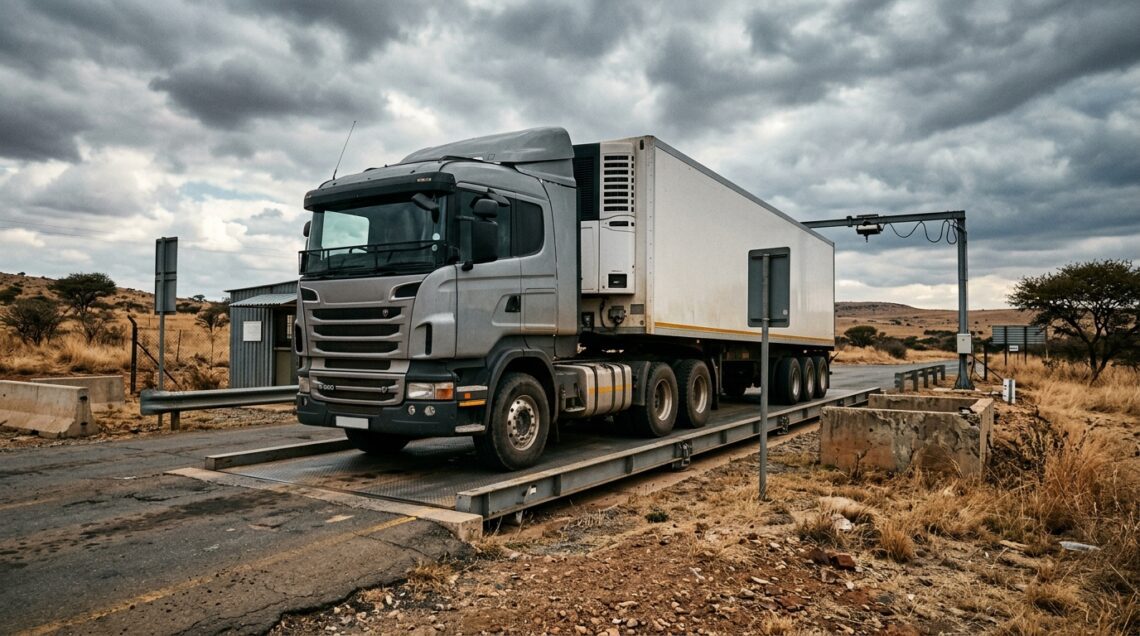
Getting pulled into a weighbridge when you’re carrying 24 pallets of frozen chicken is not the time to discover your load exceeds legal limits. Yet this scenario plays out regularly on South Africa’s national routes, with consequences ranging from administrative fines to vehicle detention and load redistribution—often in 35°C ambient temperatures with product integrity at stake.
The National Road Traffic Act governs vehicle mass and dimensions on South African roads. For cold chain operators—whether you’re a fleet manager, cold store logistics coordinator, or third-party carrier—understanding these regulations prevents costly compliance failures while protecting your product and your business.
This guide consolidates the regulatory framework that governs freight loading in South Africa, with particular attention to how these rules affect refrigerated transport operations. We’ll clarify what the law actually requires versus what carriers impose as operational requirements—a distinction that often confuses shippers and receivers in the cold chain.
The Legal Framework: NRTA and Its Regulations
South Africa’s road freight regulations flow from the National Road Traffic Act, Act 93 of 1996 (NRTA), and its associated National Road Traffic Regulations (NRTR). These establish the permissible limits for vehicle dimensions, axle loads, and total vehicle mass on public roads.
Primary regulatory bodies include:
- Department of Transport (policy and legislation)
- SANRAL (South African National Roads Agency Limited—infrastructure protection)
- Provincial Traffic Authorities (enforcement)
- NRCS (National Regulator for Compulsory Specifications—vehicle standards)
- Road Traffic Management Corporation (coordination)
The regulations most relevant to freight loading are Regulations 234 through 241, with 246 addressing load securing. Together, these establish the legal boundaries within which all freight operations—including refrigerated transport—must operate.
Understanding this framework matters because exceeding any limit creates an offence. As Focus on Transport notes, selecting the incorrect vehicle or loading configuration exposes operators to prosecution when weighed at traffic control centres.
Axle Load Limits: The Foundation of Compliance
Regulation 240 establishes the maximum mass that can be carried on vehicle axles. These limits protect road infrastructure from concentrated point loading that causes accelerated pavement deterioration.
Maximum axle massloads under Regulation 240:
| Axle Configuration | Maximum Load |
|---|---|
| Steering axle | 7,700 kg |
| Single axle (non-steering) | 9,000 kg |
| Tandem axle unit (2 axles) | 18,000 kg |
| Tridem axle unit (3 axles) | 24,000 kg |
| Breakdown vehicle drive axle | 10,200 kg |
Industry note on steering axle limits: The 7,700 kg steering axle limit reflects technical specifications from the 1970s based on cross-ply tyre capabilities. Industry bodies have advocated for harmonisation with the Tripartite region at 8,000 kg, recognising that modern radial tyres comfortably exceed these requirements. Until such harmonisation occurs, however, the 7,700 kg limit remains legally binding.
These limits apply equally to all heavy vehicles regardless of body type—refrigerated trailers receive no special allowances or exemptions under the NRTA.
Gross Combination Mass: Your Overall Ceiling
Beyond individual axle limits, Regulation 237 caps the total mass of vehicle combinations at 56,000 kg for normal road transport. However, reaching this maximum depends on several factors working together.
Gross Combination Mass (GCM) represents the maximum mass of a combination of motor vehicles including the drawing vehicle and all loads, as specified by the manufacturer. For truck tractors, this determines the heaviest combination they can legally operate.
Key constraints that may prevent reaching 56,000 kg:
- Manufacturer GCM rating (cannot be exceeded even if road limits allow more)
- Power-to-mass ratio requirements
- Traction ratio requirements
- Sum of individual axle unit limits
- Bridge formula calculations (discussed below)
The legal maximum mass for any combination is the lowest value among these constraints—not automatically 56,000 kg.
Power-to-Mass Ratio: Your Engine Sets the Limit
Regulation 239 establishes that vehicles require sufficient engine power to operate safely on public roads. The formula is straightforward:
Maximum GCM = Engine Power (kW) × 240
For practical application, this means:
- A 330 kW truck tractor may pull a maximum combination mass of 79,200 kg (limited by the 56,000 kg road ceiling)
- A 220 kW truck tractor may pull a maximum of 52,800 kg (below the road ceiling)
- A 180 kW truck tractor may pull a maximum of 43,200 kg
This requirement ensures vehicles can maintain safe speeds on gradients and accelerate adequately when merging with traffic. For cold chain operations using older or smaller tractors, the power-to-mass ratio—not the road limits—may determine maximum payload capacity.
Traction Ratio: Drive Axle Loading Matters
An often-overlooked requirement relates to traction—the relationship between total combination mass and the load on drive axles.
The traction ratio rule: Total combination mass cannot exceed five times the mass on the drive axle(s).
Practical implications:
- For a 4×2 truck tractor (single drive axle with 9,000 kg limit), maximum combination is 45,000 kg—not 56,000 kg
- For a 6×4 truck tractor (tandem drive axles with 18,000 kg limit), maximum combination reaches the full 56,000 kg ceiling
This explains why 4×2 configurations, despite being more fuel-efficient for lighter loads, cannot legally operate at maximum road limits. Cold chain operators using 4×2 tractors should factor this 45,000 kg ceiling into payload calculations.
The Bridge Formula: Protecting Infrastructure
Regulation 241 introduces the bridge formula—a calculation designed to protect bridge structures by limiting concentrated loads across axle groups. The formula distributes loads based on axle spacing, recognising that widely spaced axles cause less structural stress than closely grouped ones.
Bridge formula calculation:
Maximum mass on axle group (kg) = (Distance in metres × 2,100) + 18,000
Where distance is measured from the centre of the first axle to the centre of the last axle in any group (including any combination of axles across the entire vehicle).
Worked examples:
A superlink/interlink with 19 metres between first and last axles:
- 19 × 2,100 + 18,000 = 57,900 kg → capped at 56,000 kg (road maximum)
A semi-trailer with 12 metres between first and last axles:
- 12 × 2,100 + 18,000 = 43,200 kg maximum
A shorter combination with 10 metres between first and last axles:
- 10 × 2,100 + 18,000 = 39,000 kg maximum
The bridge formula often becomes the limiting factor for shorter combinations or unusual trailer configurations. When calculating maximum payloads, verify that the bridge formula result doesn’t impose a lower limit than the sum of individual axle limits.
Vehicle Dimensions: Height, Width, and Length
Regulation 240 also governs vehicle dimensions, which directly affect cold chain operations—particularly when using high-cube containers or stacking palletised loads.
Standard dimension limits:
| Dimension | Maximum |
|---|---|
| Overall height | 4.3 m |
| Overall width | 2.7 m |
| Semi-trailer length | 18.5 m |
| Superlink/interlink length | 22.0 m |
Height exemptions:
- Buses: 4.65 m permitted
- Car carriers with RTMS permits: 4.6 m permitted
- High-cube containers with RTMS permits: 4.6 m permitted
For refrigerated trailers, height becomes particularly relevant. Standard reefer trailers with floor-mounted insulation and roof-mounted evaporators reduce internal height compared to dry vans. Operators shipping frozen goods in stacked configurations must account for both the physical height constraint and the legal limit—bridge clearances and overhead obstacles along routes add further practical limitations.
Load Securing: What Regulation 246 Actually Requires
Regulation 246 addresses load securing—and notably, what it does not require is as important as what it does.
The regulation mandates that loads:
- Must not contact the road surface
- Must not obscure the driver’s view
- Must not project dangerously
- Must be secured to prevent movement during normal operation
What Regulation 246 does NOT prescribe:
- Maximum weight per pallet
- Minimum spacing between pallets
- Specific cargo configuration patterns
- Strapping specifications or tie-down requirements
- Load distribution requirements within trailers
This absence of prescriptive cargo configuration requirements often surprises cold chain operators. The law governs the vehicle—its axle loads, total mass, and dimensions—not how cargo is arranged within legally loaded limits.
So where do those detailed loading specifications originate? They come from carriers’ operational requirements, insurance conditions, and industry best practices—not from legislation.
Weighbridge Operations: What Happens When You’re Stopped
South Africa’s weighbridge network focuses on major transport corridors, with SANRAL having invested significantly in traffic control centres along the N1, N3, and N4 routes. Understanding how these facilities operate helps cold chain operators prepare for inspections.
Major weighbridge locations:
- N1 corridor: Mantsole (between Pretoria and Bela-Bela), plus locations near Kroonstad and in the Free State
- N3 corridor: Heidelberg (compulsory stop for heavy vehicles on the N3), with additional facilities at Mooi River and other points between Johannesburg and Durban
- N4 corridor: Donkerhoek Traffic Control Centre (east of Pretoria, 24/7 operation), Bapong Traffic Control Centre (west of Brits)
Weighing technology includes:
- Weigh-in-Motion (WIM) screening at toll plazas—identifies potentially overloaded vehicles for closer inspection
- Static scales at traffic control centres—provide prosecution-grade measurements
- Electronic tagging systems—track habitual offenders
The weighing process:
When directed into a weighbridge facility, vehicles proceed to static scales where individual axle masses and total combination mass are measured. If overloaded, the vehicle is detained until the load is corrected—either through redistribution (adjusting cargo position to balance axle loads) or offloading (removing product until limits are met).
Tolerance and prosecution:
The NRTA allows a 5% tolerance on mass limits before prosecution. According to the National Overload Control Strategy, this tolerance is under review with potential reduction to 2% of Gross Vehicle Mass. Currently, approximately 20% of vehicles weighed show some overloading, but only about 2.6% exceed the tolerance level sufficient for prosecution.
Fines and consequences:
Fines for overloading range from approximately R2,000 to R10,000 depending on severity. However, the indirect costs often exceed fines: vehicle detention time, product temperature excursions, spoilage, missed deliveries, and customer penalties. For refrigerated loads, detention during high ambient temperatures creates particular urgency—product integrity deteriorates with every hour of delay.
Refrigerated Vehicle Considerations: Equipment Weight Impacts Payload
The NRTA makes no distinction between refrigerated and dry vehicles—the same axle limits and mass ceilings apply. However, refrigerated transport equipment significantly affects available payload capacity.
Weight additions for refrigerated vehicles:
| Component | Typical Weight Impact |
|---|---|
| Transport Refrigeration Unit (TRU) | 150–400 kg |
| Insulated body (vs standard) | 300–600 kg |
| TRU diesel tank (full) | 100–200 kg |
| Total additional weight | 550–1,200 kg |
This means a refrigerated trailer carrying identical external dimensions and operating under identical road limits has 550–1,200 kg less payload capacity than an equivalent dry trailer.
Calculating actual available payload:
Available Payload = GCM Limit – Tare Weight (including TRU, insulation, fuel)
For a typical 34-ton semi-trailer combination:
- Dry trailer: ~24,000 kg payload available
- Refrigerated trailer: ~23,000 kg payload available
This 1,000+ kg difference matters when loading high-density products to maximum capacity. Cold chain operators should verify their specific tare weights rather than assuming standard dry trailer capacities.
No refrigerated-specific regulations:
Weighbridges do not inspect temperature compliance—that falls under R638 food safety regulations (Department of Health), not the NRTA. The traffic control centre verifies vehicle mass and dimensions only. A load can pass the weighbridge legally while failing food safety temperature requirements, and vice versa.
What Is NOT in the Law
Understanding regulatory gaps prevents confusion about where legal requirements end and operational practices begin.
The NRTA does NOT regulate:
- Maximum weight per pallet: No legal limit exists. A 2,000 kg pallet is as legal as a 500 kg pallet, provided axle and vehicle limits are met.
- Pallet spacing or positioning: How cargo is arranged within the trailer is not prescribed by law.
- Internal cargo configuration patterns: The law doesn’t require specific loading sequences or distribution patterns.
- ATP certification: The Agreement on the International Carriage of Perishable Foodstuffs (ATP) is a European standard. South Africa has not adopted ATP as a legal requirement.
- Temperature monitoring during transport: This falls under R638 food safety regulations, not road traffic law.
- Reefer-specific inspection requirements: No separate testing regime exists for refrigerated vehicles at weighbridges.
These aspects are governed instead by carrier operational requirements (often included in service agreements), insurance conditions (Goods in Transit policies frequently specify loading requirements), industry associations (such as the Citrus Growers Association’s detailed pallet configuration guides), and customer specifications (particularly pharmaceutical and fresh produce shippers).
Carrier Requirements: Filling the Regulatory Gap
Because the law regulates vehicles rather than cargo configuration, transport carriers establish their own operational requirements to ensure legal compliance.
Typical carrier specifications include:
- Maximum weight per pallet (commonly 1,000–1,200 kg)
- Pallet positioning requirements
- Axle distribution targets
- Strapping and securing specifications
- Stack height limits
These requirements are contractual, not legal—but violating them may void insurance coverage, breach service agreements, or result in refused loads. From a shipper’s perspective, carrier requirements often feel like regulations, but understanding their contractual nature matters when negotiating terms or resolving disputes.
The Citrus Growers Association example:
Industry associations often develop detailed loading guides tailored to specific cargo types. The Citrus Growers Association, for instance, publishes configurations specifying 26–34 pallets per interlink depending on pallet weight (983–1,540 kg each), with recommended distributions of 8–10 pallets in the front trailer and 18–24 in the rear. These are operational guidelines developed through industry experience—not legal requirements—but they ensure consistent weighbridge compliance.
RTMS: Voluntary Self-Regulation
The Road Transport Management System (RTMS) represents the transport industry’s voluntary self-regulation initiative, developed in partnership with the Department of Transport, SANRAL, and the CSIR.
What RTMS is:
RTMS is an industry-led, government-supported scheme encouraging consignees, consignors, and transport operators to implement management systems demonstrating compliance with road traffic regulations. The national standard, SANS 1395-1:2019, is published by SABS and audited by SANAS-accredited certification bodies.
RTMS standard requirements include:
- Daily vehicle roadworthiness verification
- Preventive maintenance processes
- Tyre management programmes
- Speed management systems
- Driver wellness monitoring
- Loading control procedures
- Accident investigation protocols
Benefits of RTMS certification:
- Industry recognition of compliance commitment
- Potential insurance advantages
- Some permit benefits (including 4.6 m height for certain vehicle types)
- Access to self-regulation concessions
- Reduced crash rates (certified operators report 60% reductions in some cases)
What RTMS is NOT:
RTMS is not a legal requirement for transport operations. It does not prescribe specific pallet configurations. It provides a framework for demonstrating professional standards rather than detailed operational rules.
Over 11,000 vehicles currently operate under RTMS certification in South Africa. For cold chain operators selecting carriers, RTMS certification indicates a commitment to professional standards that extends beyond legal minimums.
Abnormal Loads: When Standard Limits Don’t Apply
Loads exceeding standard dimension or mass limits require exemption permits under Section 81 of the NRTA.
When permits are required:
- Dimensions exceeding standard limits (height, width, length)
- Mass exceeding 56,000 kg GCM
- Indivisible loads that cannot practically be reduced to legal limits
Permit application process:
Applications proceed through the Provincial MEC for Transport, with permits required for each province traversed. The TRH 11 document (Department of Transport) governs detailed requirements for abnormal load transport.
For cold chain operations:
Abnormal load requirements rarely affect standard refrigerated transport. However, oversized industrial refrigeration equipment, pre-fabricated cold rooms, or heavy specialised cargo may require abnormal permits. Vehicles approved for abnormal loads display an “S” marking on their licence disc.
Practical Compliance Checklist
Before loading:
- Confirm vehicle GCM rating and axle specifications
- Verify truck tractor power-to-mass ratio (kW × 240)
- Check traction ratio compliance (4×2 = 45,000 kg max)
- Account for TRU, insulation, and fuel weight in tare
- Calculate maximum payload based on lowest applicable limit
During loading:
- Monitor cumulative load weight
- Consider axle distribution as pallets are positioned
- Verify load security meets operational requirements
- Confirm load height within 4.3 m limit
Pre-departure:
- Obtain load weight documentation
- Verify driver holds appropriate licence (Code EC/C)
- Confirm vehicle roadworthiness documentation current
- Ensure temperature monitoring equipment operational
If stopped at a weighbridge:
- Proceed to scales as directed
- Provide documentation when requested
- If overloaded, assess options: redistribution vs. offloading
- For refrigerated loads, prioritise product temperature monitoring
- Document any detention time for insurance and customer notification
Key Takeaways for Cold Chain Operators
- The law regulates vehicles, not cargo configuration. Axle limits, GCM, and dimensions are legally prescribed. Pallet weights, spacing, and loading patterns are not.
- Refrigerated vehicles have no special regulatory status. The same rules apply—but TRU equipment reduces available payload by 550–1,200 kg compared to dry vehicles.
- Carrier requirements fill the regulatory gap. Per-pallet limits, loading patterns, and position restrictions are operational requirements ensuring legal compliance, not legal requirements themselves.
- Weighbridges check vehicles, not pallets. Compliance is measured at axle and total mass level. Temperature compliance falls under separate food safety regulations.
- Insurance requires more than legal compliance. GIT coverage typically requires meeting carrier specifications, which may exceed legal minimums.
- RTMS is voluntary but valuable. Not a legal requirement, but demonstrates professional standards and may provide operational advantages.
Understanding these distinctions helps cold chain operators navigate compliance confidently—knowing exactly where legal obligations end and operational best practices begin.
Sources & References
Government and Regulatory Sources
- National Road Traffic Act, Act 93 of 1996 South African Legal Information Institute (SAFLII). Consolidated Act text updated to November 2010, with subsequent amendments noted.
- National Road Traffic Regulations KwaZulu-Natal Department of Transport. Full text of regulations including mass and dimension provisions.
- TRH 11: Dimensional and Mass Limitations and Other Requirements for Abnormal Vehicles Department of Transport, 8th Edition 2010. Technical document governing abnormal load transport and permit requirements.
- National Road Traffic Amendment Act 8 of 2024 South African Government. Government Gazette 51729 of 10 December 2024, commencement to be proclaimed.
Industry and Technical Sources
- Permissible Maximum Masses Unpacked Focus on Transport and Logistics, December 2024. Detailed analysis of Regulations 234-241 including bridge formula calculations and practical application.
- Road Transport Management System: What is RTMS? RTMS-SA.org. Overview of self-regulation scheme objectives, SANS 1395-1 standard, and certification process.
- RTMS Standard (SANS 1395) RTMS-SA.org. Summary of standard requirements for transporters and consignors/consignees.
- Road Transport Management System (RTMS) and Road Safety Arrive Alive. Industry context, certification statistics, and road safety outcomes.
Infrastructure and Enforcement Sources
- Overloading and Road Safety Arrive Alive. Comprehensive overview of weighbridge infrastructure, National Overload Control Strategy, 5% tolerance provisions, and enforcement approaches.
- J Radebe: Launch of Donkerhoek Weighbridge South African Government, June 2007. Minister’s address on SANRAL weighbridge technology, electronic tagging systems, and enforcement initiatives.
- Traffic Control Centres Bakwena Platinum Corridor. Description of Brits Traffic Control Centre (BTCC) and Mantsole Traffic Control Centre (MTCC) operations on N4 corridor.
- 20% of Vehicles Weighed Overloaded, Enforcement Problematic Engineering News, June 2015. CSIR overload control statistics showing 2.6% chargeable offences from 2 million vehicles weighed.
Route and Concession Information
- N3 (South Africa) Wikipedia. Route description, N3 Toll Concession details for Cedara-Heidelberg corridor, and weighbridge locations.
- SANRAL Wikipedia. Overview of South African National Roads Agency structure, toll road operations, and regional organisation.
RTMS Certification and Case Studies
- Six More Companies RTMS Certified Focus on Transport and Logistics, May 2019. CCBSA and Africa Link certification outcomes including 60% crash reduction statistics.
- Road Transport Management System (RTMS): Making Trucking Safer Arrive Alive. Barloworld Logistics interview on RTMS implementation, safety outcomes, and industry benefits.
- RTMS JC Auditors. SANAS-accredited certification body requirements and SANS 1395-1:2019 compliance overview.
Transport Refrigeration Technical Sources
- What is a Reefer Truck? A Complete Guide to Refrigerated Transportation OTR Solutions, May 2025. TRU operations, weight capacity (42,000-44,000 lbs typical), and payload considerations versus dry vans.
- Reefer Trucking 101: Guide to Shipping Refrigerated Freight RXO, January 2025. Maximum loadable weight specifications (43,500 lbs for 53′ refrigerated trailer) and FSMA Sanitary Transportation requirements.
Penalty and Compliance Sources
- Hefty Penalties: The Most Expensive Traffic Fines in South Africa Gauteng News, June 2024. Fine ranges for overloading offences (R2,000–R10,000) and unroadworthy vehicles.
- 10 Common Traffic Fines in SA (And How to Avoid Them) AA Inform, April 2025. Overloading fine structure (R250–R1,500) based on percentage of permissible maximum mass exceeded.
Related Resources
- ColdChainSA Glossary – Cold Chain Terminology
- R638 Compliance Guide for Cold Chain Operators
- Temperature Monitoring Requirements: What South African Regulations Require
About ColdChainSA
ColdChainSA is South Africa’s dedicated cold chain industry directory and resource platform, connecting temperature-controlled logistics professionals with verified suppliers, technical resources, and industry intelligence. This article draws on regulatory documentation, industry technical sources, and operational experience in South African temperature-controlled transport. The distinction between legal requirements and industry operational practices reflects practical field experience navigating compliance requirements across Gauteng and Western Cape routes.